A semi-hard sheep and cow and goat's milk cheese from Originally the Catalan Pyrenees and pre-Pyrenees, from the Vall d'Aran to the Ripollès; today made across Catalonia. Included here as a Catalan cheese, not a Penedès one.
A pressed, uncooked cheese made first from sheep's milk by Pyrenean farmers and now also from cow's and goat's milk. ACREFA presents it as representative of Catalan cheesemaking. The name points both to the mountain ridges (serrats) where it began and to the pressed, compact paste, with little moisture and no eyes, which keeps well. Today it is made raw or pasteurised across Catalonia, far from its mountain origins.
Made in: Originally the Catalan Pyrenees and pre-Pyrenees, from the Vall d'Aran to the Ripollès; today made across Catalonia. Included here as a Catalan cheese, not a Penedès one
On the plate
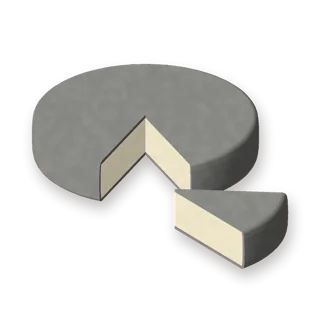
A fatty, aromatic cheese of intense flavour, slightly peppery, according to Catalan Wikipedia, which gives a thin smooth yellowish-brown rind and a compact yellow paste without holes. ACREFA stresses the dense, eyeless paste that keeps well.
Rind: natural crust
Wine and cheese
What to pour with Formatge serrat
Long-aged Corpinnat Brut Nature Penedes
Our pick
Five years or more on the lees give these zero-dosage Corpinnat wines a savoury, autolytic depth that suits a mature pressed cheese, while the bone-dry palate, high acidity and fine bead cut the fat of a serrat.
Five years or more on the lees give these single-vineyard Cavas a creamy, savoury depth that stands up to serrat's dense, fatty paste and peppery edge, and their high acidity and fine bead clean the palate between bites.
Two years or more on the lees give Gran Reserva Cava toasty or dried-fruit notes and a rounder bead; that depth stands up to serrat's dense, fatty paste, and the dry palate and high acidity cut its peppery richness.
Serrat is pressed, firm and a little peppery. Sumoll is the Penedès native red: red cherry, wild herb and rose petal, medium-bodied with firm tannin and high acidity, enough structure to match the cheese's fat and spice.
Penedès Cabernet Sauvignon, full bodied and aged in oak, has firm tannin with cedar and dark fruit; serrat's fat and dense, eyeless paste soften the tannin, and its intense, peppery flavour holds up to the wine.
Cabernet Franc aged in French oak (DO Penedès) Penedes
Our pick
Cabernet Franc from the Penedès, aged in French oak, joins high acidity to a herbal, savoury edge and fine to firm tannin; the acidity cuts serrat's fat and the herbs meet the cheese's intense, peppery flavour.
Rosé Corpinnat, bone dry after two to three years on the lees, has the red-berry fruit and grip to meet serrat's fatty, slightly peppery paste, while high acidity and a fine bead keep each mouthful fresh.
Merlot-led red aged in French oak (DO Penedès) Penedes
Our pick
Merlot-led Penedès reds aged in French oak bring plum fruit, supple tannin and a savoury finish; serrat's fat rounds the tannin and its intense, slightly peppery flavour meets the wine's savoury side.
Affineur in a 19th-century cellar in Vilafranca. It selects artisan cheeses from other makers and ages them in vats that once held wine, rather than making cheese itself. Sells cheese selections and some wine online for delivery or pick-up at its workshop, and supplies restaurants and wine shops.
Ham and charcuterie shop in Vilafranca whose own site describes a range of Spanish and international cheeses, sold in its shops rather than online. Also in Sitges, Vilanova i la Geltrú and Santa Coloma de Gramenet.
Gourmet shop of a second-generation charcuterie family selling Iberian ham, cheeses and charcuterie, with tasting in the shop, a second shop in Sant Pere de Ribes, an online shop and catering.
TastingVilafranca del Penedèsweekends, usually 13:00 or 20:00
A tour of the ageing workshop, a former wine storehouse of the 19th century with ceramic vats, then a meal of 20 cheeses with 5 wines at one of five tables. Weekends, usually at 13:00 or 20:00, in Catalan, up to 36 people; a non-alcoholic option is offered.
TastingSant Sadurní d'AnoiaMonday to Saturday by prior booking
Guided visit to the vineyard and cellar of a biodynamic estate at Can Llopart de les Alzines, then a commented pairing of five Catalan cheeses with its wines and Cavas, set up as a contrast pairing and a complementary one. Its own page lists Blanc de Sora, Puigpedrós, Lligat de cabra, Serrat and Blau ceretà. Monday to Saturday by prior booking, minimum two people; wheelchair accessible.
TastingTorrelavitSaturdays at 11:15 in Catalan, Sundays and holidays at 11:15 in Spanish
Guided winery visit with a pairing of 4 wines and 4 artisan cheeses. Saturdays in Catalan, Sundays and holidays in Spanish, both at 11:15. Ages 7 to 17 pay EUR 22 and get cheeses and grape juice; under 7 free, with grape juice.
Visits and cheese workshops at a small raw-milk dairy in Sant Sadurní d'Anoia, Monday to Friday by prior reservation, according to its own site. ACREFA adds tastings and direct sale of its sheep's and cow's milk cheeses.
TastingPacs del PenedèsSaturdays 12:30 in Spanish, Sundays 11:45 in Catalan
Guided visit with an audiovisual presentation, the Mas La Plana vineyard, a solar-electric train to the Waltraud cellar, ending with four wines each matched to an artisan cheese. Year round on weekends: Saturdays at 12:30 in Spanish, Sundays at 11:45 in Catalan.
Formatge serrat: questions
What does serrat mean?
ACREFA says the word points both to the mountain ridges (serrats) where it was made and to a pressed, compact cheese. It cites the saying that cheese should be serrat and bread ullat, meaning closed and full of holes.
What milk is serrat made from?
Originally sheep's milk. ACREFA says it began to be made with cow's milk in the early 20th century and with goat's milk from the 1980s, and that raw and pasteurised versions both exist.