Munster with Gewurztraminer ★ 4.9
French Wikipedia and Je Visite Alsace both give this match: Gewurztraminer's aromatic power and full body stand up to the strength of the cheese, and its richness softens the pungent washed rind.
Bottles to try:
The local cheeses of Alsace with the local wines that suit them, and why they work.
The cheeses of Alsace with the wines made beside them. Pairings marked as a local tradition are the ones a regional source names; the rest are our own picks, and say so.
French Wikipedia and Je Visite Alsace both give this match: Gewurztraminer's aromatic power and full body stand up to the strength of the cheese, and its richness softens the pungent washed rind.
Bottles to try:
French Wikipedia lists late-harvest and noble-rot Gewurztraminer with Munster. The wine's sweetness plays against the salty, pungent rind, a sweet-and-savoury contrast.
Bottles to try:
Alsace field blends, Riesling, Pinot Gris and other noble grapes planted together, join Pinot Gris body to Riesling acidity. Dry or off-dry, they stand up to Munster's pungent washed rind and soften its salt.
Bottles to try:
French Wikipedia says Munster goes with Riesling, though above all with Gewurztraminer. A dry Riesling's acidity cuts the creamy paste and the pungency of the washed rind without adding sweetness.
Bottles to try:
Skin-macerated Pinot Gris has full body, high acidity and a modest tannic grip, with dried apricot and citrus peel. That texture stands up to a pungent washed rind where a plain white would fade.
Bottles to try:
Bargkass is mild and low in salt, tasting of hay and fresh grass. A dry Riesling's acidity lifts the supple, melting paste without covering its gentle summer-pasture flavour.
Bottles to try:
Cœur de Massif is a mild, supple, creamy cooked-pressed cheese. A Pinot Gris with some body, dry or lightly off-dry, matches that weight and creaminess without drowning the paste's gentle flavour.
Bottles to try:
Garlic, shallot and chives in a cold fresh cheese call for a dry white with gentle fruit and fresh acidity. Pinot Blanc keeps the herbs and the boiled potatoes in front rather than competing with them.
Bottles to try:
Pinot Gris, dry or lightly off-dry, has the body to keep pace with Munster's supple, unctuous paste without the perfume of Gewurztraminer. It suits a young, mild cheese better than an old, runny one.
Bottles to try:
Sylvaner is a dry, fresh white with high acidity and restrained fruit, gentle enough for a mild pressed cheese that tastes of hay and fresh grass, so neither side overpowers the other.
Bottles to try:
Alsace Pinot Noir is medium-bodied, with bright acidity and modest tannin, so it meets the supple, creamy paste of a mild pressed cheese without drying it out or covering its flavour.
Bottles to try:
A light skin-contact blend of Pinot grapes and Gewurztraminer, low in tannin with medium acidity. Its gentle grip cuts the cream of a cold fresh cheese of garlic and chives without burying the herbs.
Bottles to try:
Dry bubbles and fine acidity cut through the creamy paste of a washed-rind cheese, a lighter route for anyone who finds Gewurztraminer too perfumed. Choose a brut or extra brut.
Bottles to try:
A dry Alsace blend of several white grapes, fresh and fruity rather than weighty. Its acidity cuts the cream in a herby fromage blanc eaten cold with potatoes boiled in their skins.
Bottles to try:
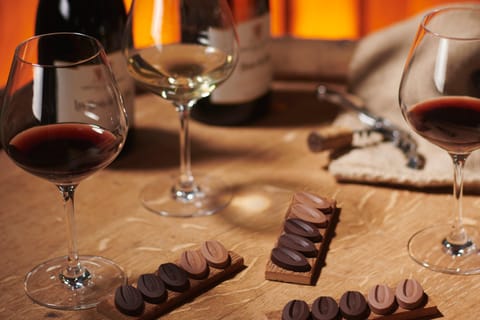
Enjoy a taste break with wine and chocolates for a fun and informative moment of relaxation!
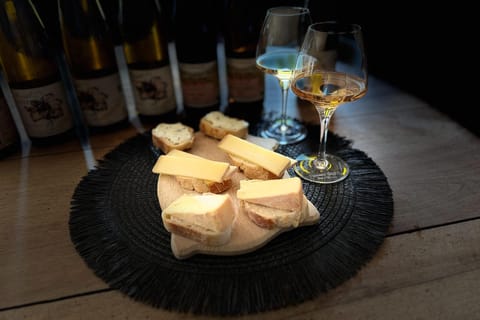
Dare to go beyond traditional pairings! Discover three local cheeses, including the must-have Munster, and experiment with six gourmet pairings with organic Alsatian w...
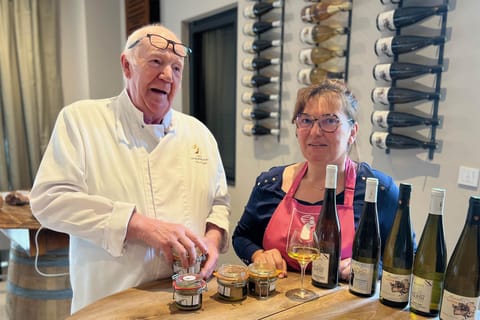
Discover the subtleties between goose and duck foie gras paired with our organic Alsace wines. Experience unique pairings with dry or sweet wines during this exception...
INAO describes a powerful, ammonia-tinged smell, while Le Guide du Fromage describes a supple, unctuous, mild paste with dairy, hay and nut notes.
Gewurztraminer is the classic answer: French Wikipedia says Munster goes with Riesling and above all Gewurztraminer, including late-harvest and noble-rot bottlings. A regional guide, Je Visite Alsace, calls Gewurztraminer the royal match, Pinot Gris a more discreet one, and advises against tannic reds.
Yes. Le Guide du Fromage lists one appellation, Munster or Munster-Géromé, with the two names coming from the Alsace side (Munster) and the Lorraine side (Géromé, from Gérardmer) of the Vosges.
It can. Le Guide du Fromage says caraway seeds are optionally added to the curd, and French Wikipedia says the cheese may be eaten with caraway; the cheese is otherwise the same.
No. Wikipedia says it has no protected designation because each farm has its own recipe, and Château Landsberg's guide also lists it as outside the AOP, AOC and IGP schemes.
Wikipedia gives the Alemannic roots: barg means mountain and käss means cheese, so mountain cheese.
Le Guide du Fromage says it is a spin-off of Munster: a cheese made to keep, produced in the same farms when milk is abundant and Munster sales are slow.
A cheese made since 2015 mainly from Vosgienne cow milk, created by breeders in the Vosges massif to support the breed, per ici (formerly France Bleu) and Le Guide du Fromage.