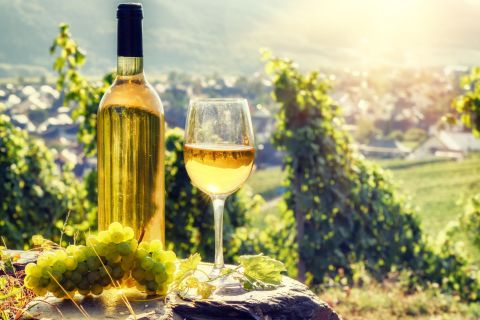
Alsace Half-Day Wine Tour from Strasbourg
Depart from Strasbourg on a half-day tour along the Alsace wine route to discover some of the best wines of France. Visit 2 wineries, learn about the 7 types of Alsace wines.
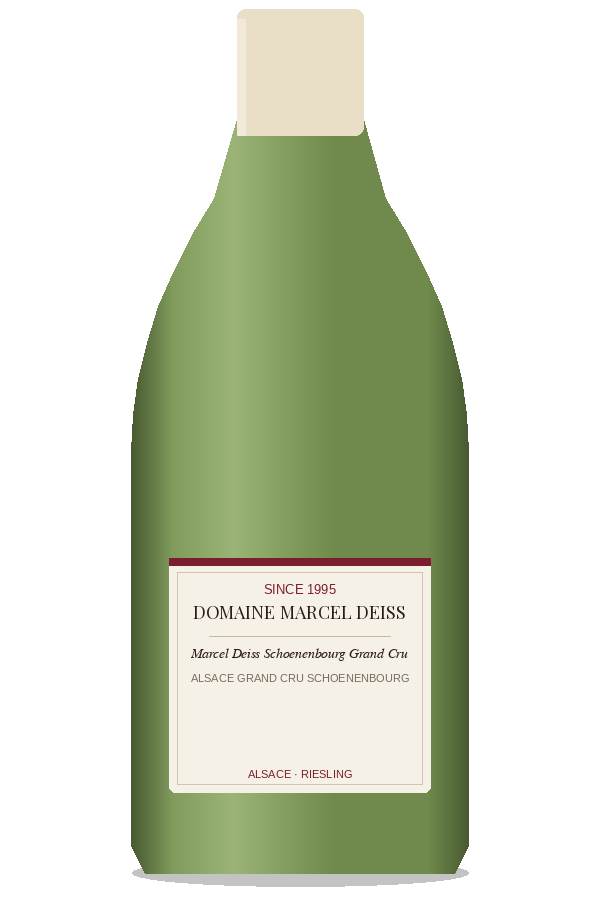 Pale gold
Still White · Alsace Grand Cru Schoenenbourg · Alsace
Deiss's complanted Schoenenbourg above Riquewihr, marl-and-gypsum soils, Riesling-dominant. Cooler and more racy than Altenberg or Mambourg.
No critic score is published for this bottle that we can cite with a reviewer, a vintage and a review year, so none is shown. The rating in the header is our own.
Aroma: lemon, white peach, white flower, wet stone
Palate: green apple, candied lemon, saline minerality, spice
Deiss's complanted Schoenenbourg above Riquewihr, marl-and-gypsum soils, Riesling-dominant. Cooler and more racy than Altenberg or Mambourg.
Allow 5 minutes from open to pour.
Schoenenbourg above Riquewihr was a historically renowned Alsace vineyard whose wines were enjoyed by Voltaire. Deiss complants it as a field-blend Grand Cru.
On the nose, lemon, white peach, white flower, wet stone. On the palate, green apple, candied lemon, saline minerality, spice. Structurally medium-bodied, racy acidity with a long finish. Deiss's complanted Schoenenbourg above Riquewihr, marl-and-gypsum soils, Riesling-dominant. Cooler and more racy than Altenberg or Mambourg.
Drink 8-30 from vintage. Young vintages benefit from 30-90 minutes of decanting; mature bottles should be handled carefully for sediment.
Pike quenelle Nantua is the canonical pairing. Other strong matches include Plateau de fruits de mer and Coq au Riesling. Cream-sauced freshwater fish for the wine's stone and citrus.
The blend is Riesling, Pinot Gris, Gewurztraminer, Muscat. The wine is classified as Alsace Grand Cru Schoenenbourg.
Depart from Strasbourg on a half-day tour along the Alsace wine route to discover some of the best wines of France. Visit 2 wineries, learn about the 7 types of Alsace wines.
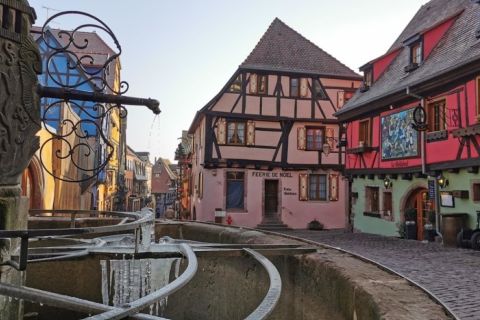
Experience half a day on the famous wine road of Alsace to visit Hunawihr, Riquewihr, and a winemaker cellar with wine tasting! This is the perfect way to get an overv...
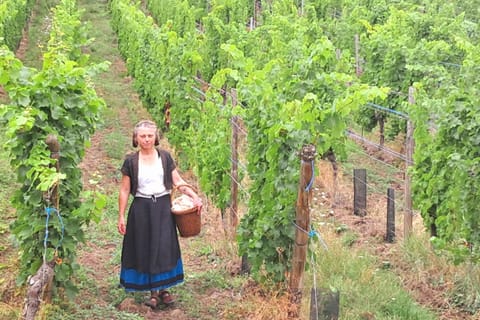
Authentic Alsatian immersion in picturesque Riquewihr - with the option of wine tasting - accompanied by a costumed local character. Where Alsatian history and tradition meet.