DOP, first protected 1993Cow milk, pasteurisedSemi, softNatural rindAlso Queixo Tetilla
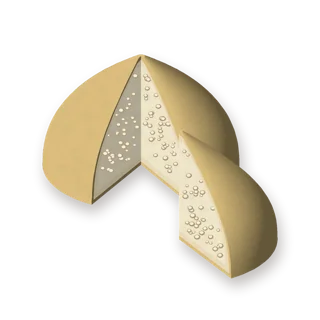
A soft, creamy cow's milk cheese sold as a rounded cone with a small nipple at the tip, which gives it its name (tetilla means small breast). The consortium rules call for a concave-convex cone 9 to 15 cm tall, with a thin straw-yellow rind under 3 mm, weighing 0.5 to 1.5 kg. It has had a Denominación de Origen since 1993 and European protection since 1996. It is a Galician cheese rather than a Rías Baixas one; its Pontevedra makers sit inland in the Deza country around Lalín and Agolada.
Taste: Natural, milky, slightly acidic and mildly salty, with a soft, creamy, uniform paste, according to the consortium, which presents it as an everyday cheese suited to many palates.
Ageing: At least 8 days, counted from the day after making; sold young
Made in: Galicia; traditionally the east of A Coruña province around Curtis, Arzúa and Melide, with makers today in A Coruña, Lugo, Pontevedra and Ourense provinces
DOP, first protected 1995Cow milk, bothSemi, softNatural rindAlso Queixo Arzúa-Ulloa
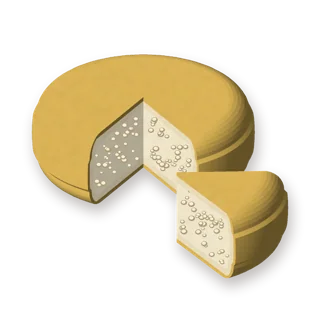
The cheese Galicia produces and consumes most, according to the organisers of the Arzúa cheese fair. A lenticular wheel, usually 18 to 20 cm across and 6 to 8 cm high (the register allows up to 26 cm and 3.5 kg), with a thin, elastic, glossy yellow rind. The ivory paste is soft with a few small, irregular eyes. It is made from raw or pasteurised cow's milk, and a farmstead version, Arzúa-Ulloa de Granxa, must use only the maker's own herd. It was recognised as a Denominación de Origen in 1995 and entered the EU register of protected designations in 2010. The core area is around Arzúa and Melide in A Coruña, with the DOP also reaching Pontevedra municipalities such as Lalín, Silleda and A Estrada.
Taste: Lactic, slightly acid and lightly salted, with butter and yogurt notes; sweeter flavours appear as it matures, according to the Arzúa cheese fair organisers.
Ageing: At least 6 days; Galician Wikipedia puts the best eating at 15 to 40 days from making
Made in: Municipalities along the Ulla valley in A Coruña, Lugo and Pontevedra provinces, from Arzúa and Melide to Chantada, Lalín and A Estrada
DOP, first protected 1995Cow milk, bothHardNatural rindAlso Queixo da nabiza
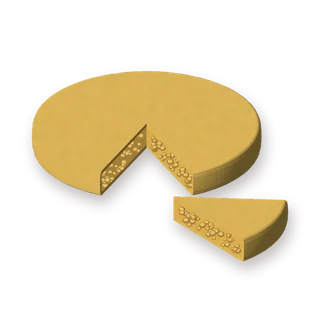
The aged type of the Arzúa-Ulloa DOP (a Denominación de Origen since 1995, on the EU register since 2010), matured for at least six months instead of days. It is a lenticular or cylindrical wheel, 12 to 20 cm across and 3 to 10 cm high, 0.5 to 2 kg, and the top face may be slightly concave. The rind is not distinct from the paste, a glossy, greasy, very intense yellow. The paste is deep yellow, very compact, with few eyes. Spanish Wikipedia gives its traditional Galician names as queixo da nabiza, queixo do tempo dos nabos and queixo do ano.
Taste: Salty, low in acidity, with medium to low bitterness and mostly butter flavour with light vanilla and nut notes, according to the register text; Spanish Wikipedia adds a strong aroma of slightly rancid butter.
Ageing: At least 6 months
Made in: Same DOP area as Arzúa-Ulloa: the Ulla valley in A Coruña, Lugo and Pontevedra provinces

DOP, first protected 1999Cow milk, bothSmokedNatural rindAlso Queixo San Simón da Costa
A smoked cow's milk cheese shaped like a pear or spinning top that ends in a small nipple, from the Terra Chá in the north of Lugo province, a long way from the Rías Baixas. Spanish Wikipedia describes a hard, waxy, glossy brown rind 1 to 3 mm thick and a semi-firm paste from white to yellow with a few small eyes. Large cheeses weigh 0.8 to 1.5 kg and stand 13 to 18 cm tall; the small bufón is 0.4 to 0.8 kg and 10 to 13 cm. The consortium dates its national recognition to 1999 and European registration to 2008, and cites an 1857 newspaper article as the oldest mention.
Taste: Mild, with a touch of spice, low in fat and salt, and the aroma of birch smoke, according to Spanish Wikipedia. The paste is creamy and turns from white when young to yellow as it ripens.
Ageing: At least 45 days (large format) or 30 days (small bufón), smoked over birch wood
Made in: Terra Chá, Lugo province: Vilalba, Muras, Xermade, Abadín, Guitiriz, Begonte, Castro de Rei, Cospeito and A Pastoriza

DOP, first protected 2005Cow milkFreshAlso Queixo do Cebreiro
A fresh cow's milk cheese shaped like a mushroom or chef's hat: a cylindrical base, at most 12 cm high, topped by a cap 1 to 2 cm wider and at most 3 cm high, about 15 cm in all and 0.3 to 2 kg. It comes from the mountains of eastern Lugo, where the Camino Francés enters Galicia, far from the Rías Baixas. The fresh paste is white and clay-like, with no distinct rind, made from drained curd that is hung in cloth bags and then kneaded. The Agriculture Ministry ratified its Denominación de Origen rules by Orden APA/1559/2005 of 17 May 2005, which gave it provisional national protection, and the EU registered the DOP in 2008. Tradition credits the monks who settled at O Cebreiro, and Spanish Wikipedia says two dozen cheeses went every year to the Portuguese royal house under Charles III.
Taste: Fresh, a milky flavour with a slight acidity, according to Spanish Wikipedia. The optional cured version has a yellow paste and a somewhat metallic, spicy and milky taste.
Ageing: Fresh cheese goes on sale after at least an hour at 2 to 6 C; the optional cured version needs at least 45 days at 10 to 15 C
Made in: Thirteen municipalities in the mountains of eastern Lugo province around O Cebreiro: Baleira, Baralla, Becerreá, Castroverde, Cervantes, Folgoso do Courel, A Fonsagrada, Láncara, Navia de Suarna, As Nogais, Pedrafita do Cebreiro, Samos and Triacastela

Cow milkFresh
Galicia's traditional fresh curd cheese, made by draining curdled cow's milk. Depending on the draining time it ranges from a spoonable cream like yogurt to a mass as firm as fresh cheese. It has no added salt and is eaten as a dessert with sugar or honey. The requeixo of As Neves, made by the Condado-Paradanta cooperative, is a well-known one, and the town's requeixo and honey fair is a Festa de Interese Turístico de Galicia. No protected name is recorded in the sources.
Taste: Mild, milky and unsalted, from a spoonable cream to a firmer mass depending on draining time. The Condado-Paradanta cooperative describes a pearly look and a fresh aroma.
Ageing: Fresh
Made in: Galicia; a well-known one is the requeixo of As Neves, a town in the Condado do Tea in Pontevedra province