Atelier Éveil des sens, champagnes et fromages ★ 4.2
Near Reims cathedral, a 90-minute workshop with two champagnes, a glass of ratafia and three regional cheeses. Book at least 24 hours ahead; French, English or Russian, 2 to 20 guests.
Cheese tastings, cave tours, markets and cheese routes in Champagne.
A guide to cheese experiences in Champagne.
Near Reims cathedral, a 90-minute workshop with two champagnes, a glass of ratafia and three regional cheeses. Book at least 24 hours ahead; French, English or Russian, 2 to 20 guests.
Reims covered market in a concrete hall of 1927 to 1929 with a 19.85 m vault, restored and reopened in 2012. The tourism office lists regular markets on Friday and Saturday; French Wikipedia also lists Wednesday. A 2014 local guide named three cheese counters; stalls change.
Troyes market hall inaugurated in 1874, with eighteen cast-iron posts. It sells andouillette, cheeses and champagne among other local produce; Pouillot, an affineur, has a stall.
At Chaource, in the Aube, a free viewing gallery and film show Chaource AOP ladled by hand; there is no production at weekends. Groups of 20 or more can book a guided visit with tasting.
At Vaux-sous-Aubigny, Haute-Marne, a visit along the production stages of Langres and Époisses on Friday and Saturday late mornings by reservation. The cheese bar is shown as temporarily closed.

during this discovery of Blanc de Noirs champagnes that pair perfectly with cheeses from our regions and other areas. Join us just a stone's throw from Notre-Dame de R...
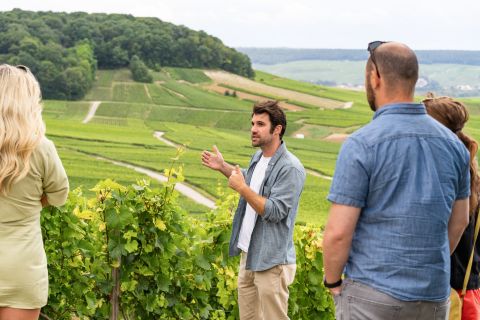
Embark on a shared or private group tour to discover the Champagne region and enjoy an authentic French lunch. Visit a world-famous champagne house and a family-owned ...
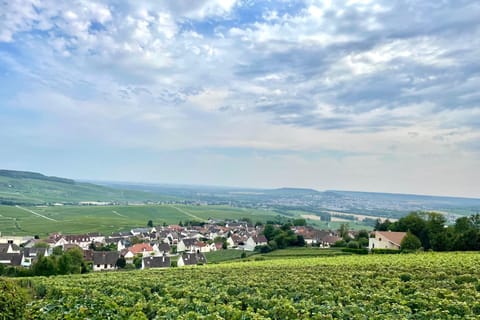
Embark on a alll inclusive day trip from Paris to the Champagne region. Visit the birthplace of champagne in 3 different houses, Reims Cathedral, and enjoy a gourmet 3...
In the Aube and Yonne departments, in the Champagne Humide, a clay region on the border of the two, according to the Institut national de l'origine et de la qualité.
At least 14 days from renneting, with at least 8 days at 8 to 14 °C, per the appellation rules summarised on French Wikipedia. INAO describes the cheese at 14 days as mushroom, hazelnut and cream.
The large format weighs 450 to 700 g, made in moulds 110 to 115 mm across, and the small format 250 to 380 g in moulds 85 to 90 mm across, per French Wikipedia.
The consortium says the fontaine forms naturally because the cheese is never turned during making. Some producers ripen it with marc, and the alcohol poured into the dip spreads through the cheese.
Montbéliarde, Brune or Simmental cows, with Prim'Holstein allowed only below half the herd. Grazing must last at least six months a year, per the consortium.
The usual format weighs 280 to 300 g and measures 10 cm across and 5 to 6 cm high, per French Wikipedia.
INAO records the French appellation in 1991. Its Langres page also lists the European Commission regulations of 1996 and 1997 on the register of protected designations; the later dates sometimes quoted, 2009 (French Wikipedia) and 2012 (the consortium), are those of the revised rules and their European approval, not the first protection.
Part of its protected area lies in the Champagne departments of Marne, Aube and Haute-Marne, per INAO and the brie syndicate, but its home is Seine-et-Marne in the Île-de-France.