
AOP, first protected 1970Cow milkSoft, bloomyBloomy rind
A tall, small cylinder of whole cow's milk set slowly by lactic acidity and drained naturally, then dry-salted on the surface. A felted white bloom forms during ageing. INAO places it in the Champagne Humide, a clay region on the Aube and Yonne border, and French Wikipedia dates the first written traces of local cheesemaking to the 14th century. It has been an appellation since 1970 and a protected designation since 1996. Two formats exist, about 250 to 380 g and 450 to 700 g.
Taste: Fresh mushroom, forest floor, hazelnut and cream at 14 days; with age a creamy layer builds under the rind and the aromas deepen. The paste is salted, fine and firm yet creamy.
Ageing: 14 days minimum from renneting, at least 8 of them at 8 to 14 °C
Made in: Aube (Troyes arrondissement) and Yonne (Avallon and Sens arrondissements), in the clay country of the Champagne Humide

AOP, first protected 1991Cow milkSoft, washedWashed rind
A cylindrical to slightly conical washed-rind cheese with a dip in the top, made on the Langres plateau of Haute-Marne, which INAO places between Burgundy and Champagne. The milk comes from Simmental, Montbéliarde and Brune cows that must graze at least six months a year. The hollow, called the fontaine, forms by itself because the cheese is never turned during making. Some wheels are ripened with marc, and the alcohol poured into the dip soaks through the cheese. Recognised as an appellation in 1991. The usual format is about 10 cm across and 5 to 6 cm high.
Taste: A fine, melting paste with a fruity, lactic character that the consortium compares to yoghurt and cream, of agreeable intensity without excess, under a rind that darkens from light yellow to red-brown with age.
Ageing: 15 days for small formats, 18 for medium, 21 for the large cut format
Made in: Two Haute-Marne arrondissements (Chaumont and Langres), the canton of Neufchâteau in the Vosges and four villages of the Côte-d'Or; INAO places the pastures on the Bassigny and Langres plateau, between Burgundy and Champagne

AOP, first protected 1980Cow milk, rawSoft, bloomyBloomy rind
A large flat disc of raw cow's milk. Its name comes from the Brie country around Meaux in Seine-et-Marne, but the protected zone also takes in parts of the Aube, Marne and Haute-Marne of Champagne, as well as the Meuse, Yonne and Loiret. French Wikipedia says the Meuse supplies over 70 percent of the milk. Appellation since 1980. Wheels are 36 to 37 cm across and average 2.8 kg.
Taste: Cream, butter and hazelnut, with a hint of forest floor in some wheels. INAO describes the paste as uniform and cream-coloured, from supple to slightly flowing when fully ripened, under a fine white rind sprinkled with red spots.
Ageing: At least 4 weeks; the brie syndicate gives 4 to 8 weeks
Made in: All of Seine-et-Marne plus parts of Aube, Loiret, Marne, Haute-Marne, Meuse and Yonne

AOP, first protected 1980Cow milk, rawSoft, bloomyBloomy rind
Smaller and stronger than Brie de Meaux, a raw cow's milk brie from Seine-et-Marne and a list of communes in the Aube and the Yonne, so only the Aube touches Champagne. A fine white-felted rind is marked with red-brown streaks. French Wikipedia puts the usual wheel at 27 cm and 1.5 kg and notes an aged, drier and darker form called Brie noir. Appellation since 1980.
Taste: Stronger in flavour and smell than Brie de Meaux, with a slightly salty edge, per French Wikipedia; the brie syndicate describes lactic flavours and a more pronounced taste. The aged Brie noir is drier and brown, with a stronger flavour again.
Ageing: About 10 weeks per French Wikipedia; the brie syndicate gives 5 to 12 weeks
Made in: All of Seine-et-Marne plus listed communes of the Aube and the Yonne
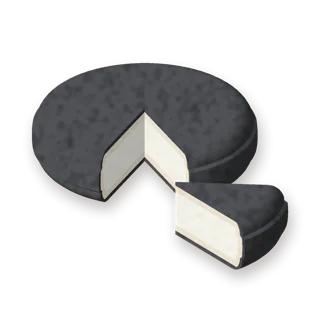
Cow milkSoft, bloomyAsh rind
An unprotected ash-ripened disc of partly skimmed cow's milk. Supertoinette calls it the heir to the old cendré des Riceys of the Aube. After about three weeks in a humid cellar the cheese spends roughly a week under poplar or beech wood ash, then two to three weeks on a rack. It is about 11 cm across and 3 cm thick. French Wikipedia lists a related cendré d'Argonne.
Taste: A soft paste under a flowering, ash-covered rind. Supertoinette says the taste recalls Brie with an added small smoky note.
Ageing: About 3 weeks in a humid cellar, about a week under ash, then 2 to 3 weeks on a rack
Made in: Champagne, as heir to the cendré des Riceys of the Aube