Key eras
Roman Gallo viticulture and the chalk crayeres
3rd to 5th century AD
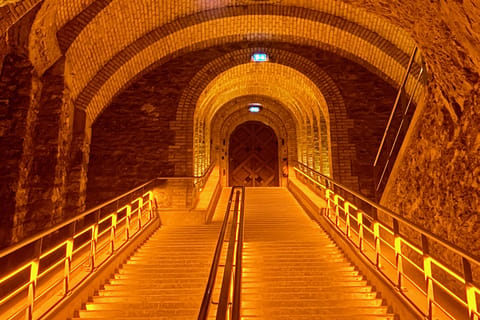
Gallo-Roman settlers planted vines on the chalk hillsides around Durocortorum, today Reims, and quarried the soft chalk for building stone. The pyramid-shaped pits they left behind, the crayeres, became the cool deep cellars that great Champagne houses still use to age bottles today.
The Saint-Nicaise hill crayeres in Reims, dug by the Romans and reused as Champagne cellars, are documented in the UNESCO Coteaux, Maisons et Caves de Champagne inscription.
Coronation wines of Reims
9th to 16th century
From the crowning of the Frankish kings at Reims Cathedral, the still wines of the Champagne hillsides were poured at coronation banquets. The royal association gave the region prestige long before the wine learned to sparkle, and abbey vineyards at Hautvillers and Ay supplied the table.
The Union des Maisons de Champagne history pages document the still coronation wines of Reims and Ay served to the kings of France.
Dom Perignon at Hautvillers Abbey, 1668
1668 to 1715
Pierre Perignon, cellar master at the Benedictine abbey of Hautvillers from 1668, refined blending across villages and grapes, pressing reds quickly to make pale wine and improving clarity.
The Hautvillers abbey history and the Comite Champagne both record Dom Perignon as cellar master from 1668 and credit him with blending and pressing advances rather than the invention of bubbles.
Bottle fermentation and the methode traditionnelle
17th to 18th century
Champagne sparkles because of a second fermentation triggered in the sealed bottle, where added yeast and sugar produce trapped carbon dioxide.
The Comite Champagne method pages describe the secondary fermentation in bottle, the prise de mousse, that defines the traditional method.
Ruinart founded in Reims, 1729
1729
Nicolas Ruinart founded a house dedicated to sparkling Champagne in Reims in 1729, building its cellars in the Roman crayeres of the Saint-Nicaise hill. Ruinart helped turn a regional curiosity into an export trade.
The Ruinart house history and the Comite Champagne both date the maison's founding to 1729.
Rise of the grandes marques, 18th century
1729 to 1827
After Ruinart, a wave of trading houses turned Champagne into a luxury export: Taittinger roots to 1734, Moet to 1743, Clicquot to 1772, Heidsieck to 1785 and Bollinger to 1829. These merchant maisons built the global brand identity that still defines the region.
The Union des Maisons de Champagne house directory documents the founding years of Moet, Veuve Clicquot, Heidsieck and Bollinger.
Veuve Clicquot and the riddling table, 1816
1816
Barbe-Nicole Clicquot Ponsardin, widowed at 27, devised the table de remuage around 1816, drilling holes in a table to riddle bottles neck-down so the dead yeast could be removed cleanly.
The Veuve Clicquot heritage pages credit Madame Clicquot with the invention of the riddling table and an early blended rose.
Maison houses of the Avenue de Champagne
1811 to 1900
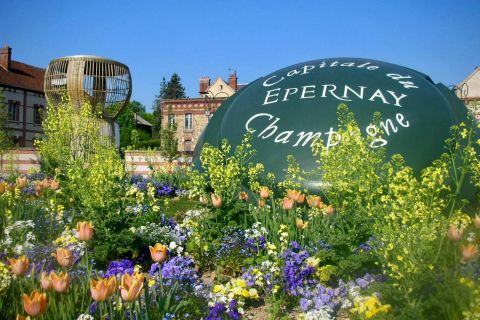
Epernay grew rich on Champagne as houses lined the Avenue de Champagne above kilometres of chalk cellars. Perrier-Jouet was founded in 1811 and Pol Roger in 1849, and the boulevard became known as the most expensive avenue in the world for the value of the bottles ageing beneath it.
The UNESCO inscription and the Perrier-Jouet house history document the Avenue de Champagne in Epernay and its underground cellars.
Phylloxera reaches Champagne, 1890s
1890 to 1900
The phylloxera louse that devastated French vineyards reached Champagne in the 1890s, forcing growers to replant on grafted American rootstock.
The Comite Champagne and regional histories date the arrival of phylloxera in Champagne to the 1890s and the subsequent replanting on American rootstock.
The Champagne riots, 1911
1911
Furious at houses buying cheap grapes from outside the region and at proposed boundary lines, growers in the Marne rioted in 1911, looting cellars at Ay and tipping wine into the streets.
Histories of the 1911 Champagne riots document the grower unrest in Ay and the dispute over the appellation boundaries.
Echelle des Crus and the Grand Cru villages
1911 to 1919
Champagne ranked its villages on a percentage ladder, the Echelle des Crus, with seventeen villages rated 100 percent as Grand Cru and a further band as Premier Cru.
The Comite Champagne and Union des Maisons de Champagne describe the Echelle des Crus village ranking and the Grand Cru and Premier Cru tiers.
Champagne AOC delimitation, 1927
1919 to 1927
A 1927 law fixed the geographic limits of the Champagne appellation, defining the communes whose grapes could be made into Champagne and the permitted grape varieties.
The Comite Champagne dates the legal delimitation of the Champagne appellation area to 1927 following the boundary disputes of 1908 to 1911.
Founding of the Comite Champagne, 1941
1941
The Comite Interprofessionnel du Vin de Champagne, the CIVC, was created in 1941 to bring growers and houses under one interprofessional body.
The Comite Champagne describes its own founding in 1941 as the interprofessional body of growers and houses.
Global protection of the Champagne name
1919 to present
Champagne is one of the most fiercely defended names in wine. The Comite Champagne pursues misuse of the word worldwide, from sparkling wines to perfumes and sweets, arguing that only sparkling wine from the delimited region may carry the name.
The Comite Champagne documents its worldwide programme to protect the Champagne appellation name against misuse.
The prestige cuvee era
1876 to 1980s
Champagne invented the luxury tete de cuvee: Cristal was created for the Russian tsar in 1876, Dom Perignon launched its first commercial vintage with 1921 released in 1936, and houses such as Roederer, Krug and Taittinger built a tier of collectible prestige bottlings above their non-vintage wines.
House histories for Dom Perignon and Louis Roederer Cristal document the creation of the prestige cuvee category.
UNESCO World Heritage listing, 2015
2015
On 28 June 2015, UNESCO inscribed the Coteaux, Maisons et Caves de Champagne, the hillsides, houses and cellars, on the World Heritage List.
The UNESCO World Heritage Centre lists Champagne Hillsides, Houses and Cellars, inscribed in 2015 as reference 1465.
The grower Champagne movement
1990s to present
A new generation of recoltant-manipulant growers, who grow and bottle their own fruit rather than selling grapes to the houses, turned grower fizz into a global category.
Decanter and trade profiles document the rise of recoltant-manipulant grower Champagne from the 1990s onward.
The greening of Champagne
2010s to present
After decades of heavy chemical use, Champagne is converting to sustainable and organic farming at pace, driven by the Viticulture Durable en Champagne certification and a growing band of Demeter-certified biodynamic estates from the Cote des Bar to the Montagne de Reims.
The Comite Champagne sustainable viticulture programme documents the regional shift toward certified sustainable and organic farming.