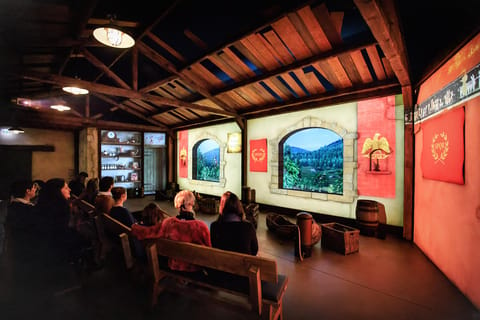
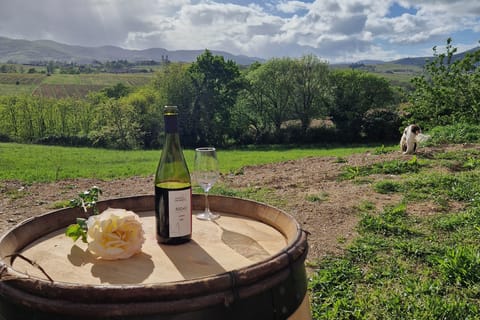
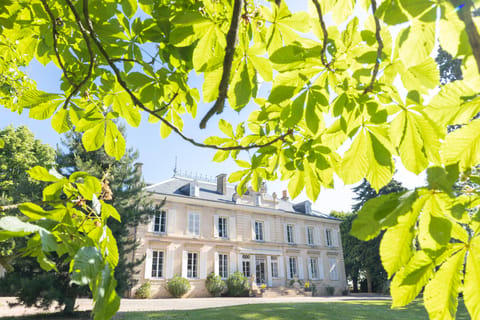
Lyon is the natural gateway to and from the Beaujolais and has been the primary market for Gamay for centuries. The bouchons lyonnais, the city's traditional working-class restaurants, still serve Beaujolais from a pot lyonnais. The Presqu'ile and Vieux-Lyon neighbourhoods have a growing number of natural-wine bars that pour the Cru appellations alongside biodynamic bottles from across France.
Pours: Beaujolais by the glass in bouchons lyonnais, Côtes du Rhône served at bistros, Crémant de Bourgogne at wine bars
Tip: Lyon is 30 minutes from the northern Beaujolais by train via Belleville-en-Beaujolais; combine a Cru visit with a Lyon bouchon dinner the same evening.
The Maconnais begins just north of the Beaujolais boundary and switches from Gamay on granite to Chardonnay on limestone. Pouilly-Fuissé beneath the Roche de Solutre is the prestige appellation; Saint-Véran and Viré-Clessé offer the same limestone Chardonnay tension at gentler prices. The visual drama of the Solutre rock makes this the most photogenic extension of a Beaujolais trip.
Pours: Pouilly-Fuissé, Saint-Véran, Viré-Clessé, Macon-Villages
Tip: Climb the Roche de Solutre for a panorama over the Pouilly-Fuissé vineyards before a tasting at Domaine Ferret or Château Fuissé; the contrast between the white-wine country and the red-granite Beaujolais is striking.
Burgundy's Cote d'Or begins north of the Maconnais. The Cote de Beaune, with Meursault, Puligny-Montrachet, and Pommard, is 90 km from central Beaujolais; the Cote de Nuits with Gevrey-Chambertin and Vosne-Romanee adds another 20 km. The contrast between the granite-driven Gamay of Beaujolais and the limestone-driven Pinot Noir of the Cote d'Or illustrates the north-south wine axis of France.
Pours: Gevrey-Chambertin, Nuits-Saint-Georges, Meursault, Pommard
Tip: Beaune is the most practical base for a Cote d'Or day or half-day from the Beaujolais; the Route des Grands Crus from Beaune to Nuits-Saint-Georges is a scenic two-hour drive.
The Benedictine Abbey of Cluny, the largest church in Christendom before Saint Peter's Basilica, stands at the centre of Saone-et-Loire wine country.
Pours: Macon-Cluny, Saint-Véran, Pouilly-Loché
Tip: The Cluny Abbey museum is free with the Departement Saone-et-Loire museum card; combine the abbey visit with an afternoon tasting at a Pouilly-Fuissé estate for a complete day.
The Northern Rhone appellations of Cote-Rotie and Condrieu begin 50 km south of Lyon along the river and represent the opposite end of French wine from Beaujolais.
Pours: Côte-Rôtie, Condrieu, Saint-Joseph, Crozes-Hermitage
Tip: Ampuis, the village at the centre of Cote-Rotie, is the best base for the Northern Rhone day; tasting at Domaine Jamet or Guigal's Les Ampuis is by appointment only but worth arranging weeks ahead.
The Pierres Dorees is the southern part of the Beaujolais where the geology shifts from the granite of the Crus to limestone-clay that turns the local stone a warm honey-gold colour.
Pours: Beaujolais AOC from Pierres Dorees limestone-granite soils, Beaujolais blanc (Chardonnay), Beaujolais rosé
Tip: Oingt is classified as one of Les Plus Beaux Villages de France; combine a walk through the medieval town with a tasting at a Pierres Dorees estate for an afternoon completely different from the granite Cru villages.
Lac d'Annecy and the Savoie wine country lie east of Lyon across the Alps. Savoie's mountain appellations produce Jacquere, Altesse, and Mondeuse on steep Alpine terraces in a completely different register from Beaujolais Gamay. The lake, the alpine scenery, and the crisp Savoie whites make this a memorable east-facing extension of a Beaujolais wine trip.
Pours: Vin de Savoie Chignin, Roussette de Savoie, Apremont, Jongieux
Tip: Annecy town is one of the most visited in the French Alps; arrive on a weekday in shoulder season to avoid summer crowds at the lake, and taste Savoie wines at the Maison des Vins de Savoie in Aix-les-Bains.
The Jura wine country east of the Beaujolais offers an entirely different viticultural world: Savagnin under voile aging to produce the oxidative Vin Jaune, Poulsard and Trousseau as pale, mineral reds, and the distinctive Ouillé versus Ouille aging debate that drives modern Jura wine conversation. Arbois, Henri Maire's hometown, is a compact wine village with several acclaimed producers on the main street.
Pours: Vin Jaune from Chateau-Chalon, Arbois Poulsard, Arbois Trousseau, Cremant du Jura
Tip: Chateau-Chalon has its own AOC (the only Vin Jaune appellation with this status); the village perched above the vineyards is worth the drive alone, but book a Vin Jaune tasting at a Chateau-Chalon producer to taste what 62 cl represents.