Key eras
Minoan Thera eruption preserves Bronze Age vineyards, c. 1613 BCE
c. 1613 BCE
The Late Bronze Age Minoan eruption of Thera buried the prosperous settlement at Akrotiri under metres of volcanic ash and pumice. Excavations from 1967 onward have uncovered Minoan-era wine jars, grape pips and a still-preserved vineyard layout sealed by the eruption layer. The eruption ejected an estimated 60 cubic kilometres of magma and reshaped the island into its present crescent caldera form. The pumice and ash deposits that buried Akrotiri became the foundation of Santorini's modern viticultural soil.
The Akrotiri Archaeological Site documentation and the Santo Wines history page reference the Bronze Age viticultural finds and the eruption layer that preserved them. The Wines of Greece official region pages cite the c. 1613 BCE date for the Late Bronze Age eruption.
Akrotiri Bronze Age wine evidence, c. 1700 BCE
17th century BCE
Excavations at the Akrotiri site have revealed wine residues inside large pithoi storage jars, grape pips, and fresco imagery suggesting an organised viticulture economy on Bronze Age Thera.
The Akrotiri Archaeological Project publications and the Wines of Greece official Santorini page both describe the Bronze Age wine production evidence at the site. Carbonised grape remains and amphora residues are catalogued at the on-site museum.
Ancient Greek viticulture on Thera, 8th century BCE to Roman period
8th century BCE to 4th century CE
Following the resettlement of Thera in the Geometric period, viticulture resumed on the volcanic soils. Ancient Greek and later Roman-era sources reference Theran wine in trade contexts.
The Wines of Greece historical overview and the Santo Wines history pages describe the continuous documented viticulture from the Geometric period through the Roman era on Thera. The kouloura training method has been documented as a centuries-old adaptation by the Santorini wine PDO authority.
Byzantine monastic viticulture, 9th to 13th century
9th to 13th century
During the Byzantine period, Orthodox monasteries on Santorini became important centres of viticulture. The Profitis Ilias monastery, on the 567-metre peak at the south end of the island, maintained extensive vineyard holdings, and the wines produced were used both liturgically and commercially. Byzantine-era documents reference Theran wine exports to Constantinople. Monastic record-keeping established many of the cultivation practices that survived through the later Venetian and Ottoman periods.
Wines of Greece and the Santorini PDO heritage documentation reference the Byzantine monastic role in maintaining viticulture on the island. Profitis Ilias monastery history pages note historic vineyard holdings.
Venetian rule and the rise of Vinsanto exports, 1207 to 1579
1207 to 1579
Under Venetian rule from 1207, Santorini wine, particularly the sun-dried sweet wine that would become Vinsanto, entered Venetian trade networks.
Wines of Greece historical pages and the Santo Wines Vinsanto heritage documentation reference the Venetian-era export trade. The Wikipedia Vinsanto entry summarises the etymology and trade route history.
Ottoman era and Russian Orthodox liturgical trade, 1579 to 1820s
1579 to 1820s
After the Ottoman conquest of the Cyclades in 1579, Santorini wine continued to be exported across the Eastern Mediterranean and to the Russian Empire, where Vinsanto was used in Russian Orthodox liturgy.
Wines of Greece and Wikipedia's Santorini wine article describe the Russian Orthodox trade in Vinsanto. Santo Wines heritage documentation references the historic export to Russia.
Phylloxera bypass: Santorini's ungrafted vines, 1860s onward
1860s onward
When phylloxera devastated European vineyards from the 1860s through the early 20th century, Santorini was almost completely spared. The combination of pure volcanic ash and pumice substrate (which the louse cannot tolerate), the island's xerothermal climate, and its geographic isolation kept the vines phylloxera-free. As a result, Santorini's vines have never been grafted onto American rootstock. Many vineyards still grow on their original European root systems, with individual plants regenerated by layering rather than replanting, producing vines whose root systems may be 70 to 200 years old.
The Wines of Greece regional documentation and academic sources cited in the Wikipedia Santorini wine entry explain the phylloxera resistance attributable to volcanic ash soils. Multiple Santorini producers including Santo Wines, Estate Argyros and Boutari reference the ungrafted-vine heritage as a regional feature.
Kouloura basket pruning: viticulture adapted to wind and aridity
Centuries-old, continuing practice
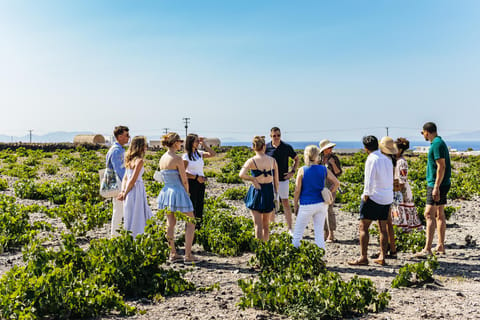
Santorini growers train each vine in a tight circular basket form known as kouloura (or ampelies), with the grape bunches developing inside the woven shape.
The Santorini PDO documentation, Wines of Greece regional pages, and Santo Wines vineyard education pages describe the kouloura system as a centuries-old adaptation. Producer websites including Estate Argyros and Sigalas reference the practice.
Venetsanos Winery built into the caldera cliff, 1947
1947
Built into the caldera cliff at Megalochori in 1947, the Venetsanos Winery was an early commercial winery on Santorini designed for gravity-flow vinification.
The Venetsanos Winery website documents the 1947 founding, the cliff-side gravity design, and the 2015 restoration. The Santorini Tourism site references the winery as a heritage destination.
Santo Wines Cooperative founded, 1947
1947
The Union of Santorini Cooperatives (Santo Wines) was founded in 1947 to consolidate the small grower base into a single marketing and vinification entity.
Santo Wines own About and history pages document the 1947 cooperative founding and the present-day operations. Wines of Greece references Santo Wines as the cooperative anchor of the appellation.
PDO Santorini appellation established, 1971
1971
Greece established the controlled appellation of Santorini in 1971, formalising the geographic boundaries, permitted varieties (Assyrtiko as the dominant white, with Athiri and Aidani in blended whites), the Vinsanto sweet-wine designation, and the minimum vineyard practices required for a wine to carry the Santorini name. PDO Santorini was established roughly two decades before many other Greek PDOs.
Wines of Greece PDO documentation and the Greek Ministry of Rural Development records confirm the 1971 establishment date. Producer websites including Santo Wines, Boutari and Estate Argyros reference the PDO status.
Boutari opens Santorini facility, 1989
1989
The Boutari family, founded in 1879 in Naoussa, established a Santorini winery facility in 1989 at Megalochori. The arrival of a major Greek wine producer with national distribution helped establish Santorini's Assyrtiko on Greek mainland and international markets through the 1990s. Boutari's Santorini Assyrtiko remains a widely available reference for the appellation outside Greece.
Boutari's own corporate site and the Santorini production facility pages document the 1989 establishment. Wikipedia's Santorini wine article references Boutari as a major early modern producer.
Mavrotragano red revival, 1990s onward
1990s onward
Mavrotragano, a nearly extinct red grape native to Santorini, was rescued from disappearance in the 1990s by a handful of producers led by Boutari and Paris Sigalas.
Boutari Santorini and Domaine Sigalas both document the Mavrotragano revival on their producer history pages. The Wikipedia Mavrotragano entry summarises the variety's near-extinction and 1990s recovery.
Vinsanto name protection: Greece-Italy agreement, 2010
2010
After bilateral negotiations between Greece and Italy, the European Union granted exclusive use of the Vinsanto name (single word) to the Greek PDO Santorini sweet wine in 2010. Italian producers continue to use Vin Santo (two words) for their distinct Tuscan sweet wines under separate PDO protection. The Santorini Vinsanto is sun-dried Assyrtiko-led, aged at least two years in oak (24 months minimum for the basic PDO Vinsanto, and longer for premium expressions).
EU eAmbrosia register of protected designations confirms the Vinsanto Santorini PDO and the name-use distinction with Vin Santo. Wines of Greece and Santo Wines Vinsanto pages document the 2010 name protection.
Vineyard area shrinkage and tourism-pressure pricing, 2010s to 2020s
2010s to 2020s
From the 2010s onward, Santorini vineyards have faced increasing pressure from tourism-driven land development. Vineyard area on the island has fallen below historic levels as plots are converted to villa accommodation.
Decanter, Wine Enthusiast and Greek trade press including Wines of Greece have covered the vineyard-area shrinkage extensively from the late 2010s. Producer statements at Santo Wines, Domaine Sigalas and Estate Argyros reference the development pressure.
Climate change advances harvest into mid-August, 2020s
2020s
Rising summer temperatures in the Cyclades have advanced the Santorini harvest into mid-August in recent vintages, a clear shift from the late-August and early-September timing of past decades.
Decanter and Wine Enthusiast coverage of recent Santorini vintages references the August harvest shift. Producer harvest reports from Santo Wines, Boutari and Sigalas reference the climate-driven timing changes.
Modern producer renaissance: Sigalas, Hatzidakis, Gaia, 2000s onward
2000s to present
From the early 2000s, a generation of estate producers including Paris Sigalas, Haridimos Hatzidakis, and Gaia Wines (with the Thalassitis cuvee aged on the seabed) expanded the international profile of Santorini Assyrtiko. Single-vineyard bottlings, oak-aged Nykteri styles, and experimental sea-aged cuvees expanded the stylistic range. Santorini Assyrtiko is now commonly placed alongside Chablis and Vinho Verde as a reference Mediterranean white in international wine writing.
Domaine Sigalas, Hatzidakis Winery and Gaia Wines producer histories record the founding and trajectory of each estate; the producers maintain About pages documenting the modern Santorini Assyrtiko programme.