Assyrtiko
Assyrtiko accounts for roughly 80 percent of Santorini's plantings and the minimum 75 percent of any PDO Santorini white under the appellation decree.
The grapes that define Santorini: the canonical varietals and how the region expresses them.
The grapes that define Santorini: the canonical varietals and how the region expresses them.
Assyrtiko accounts for roughly 80 percent of Santorini's plantings and the minimum 75 percent of any PDO Santorini white under the appellation decree.
Athiri is a long-documented Greek white variety, traditionally associated with Rhodes and the islands of the southern Aegean. On Santorini it serves principally as a blending partner in the PDO white, where it contributes citrus-driven lift, lemon-blossom aroma and a softer mid-palate to Assyrtiko's high-acid, mineral spine. The grape is also a permitted partner in PDO Vinsanto. Modern monovarietal Athiri from Santorini is rare; the variety is more often used to round the harder edges of an Assyrtiko-led blend. On Rhodes it is the main grape of the dry white PDO Rhodes and is also used in retsina.
Aidani is the third permitted white grape of PDO Santorini, present in both the dry blend (alongside Assyrtiko and Athiri) and in PDO Vinsanto.
Mavrotragano is the heritage red grape of Santorini and the centrepiece of the island's red-wine revival. The variety nearly disappeared during the twentieth century because of its low yields and drought sensitivity in an island ecosystem increasingly tilted toward Assyrtiko; only a handful of old parcels survived. From the late 1990s Paris Sigalas at Domaine Sigalas led a deliberate replanting effort, and producers including Hatzidakis, Gaia, Karamolegos and Vassaltis have followed. Modern Mavrotragano is a deeply coloured, firm-tannin dry red with aromas of dark cherry, forest floor, dried herbs and a distinctive volcanic minerality, capable of a decade or more of ageing. Most Mavrotragano labels ship under PGI Cyclades rather than PDO Santorini, which covers only the white blend.
Mandilaria is a deeply coloured, tannic red grape grown across the Greek islands and most associated outside Santorini with PDO Archanes on Crete and PDO Paros (where it is blended with the white Monemvasia in an unusual co-fermented PDO). On Santorini Mandilaria is a permitted minor partner alongside Mavrotragano and Voudomato in PGI Cyclades reds, where it contributes colour and structure rather than aroma. Standalone Mandilaria from Santorini is rare; most island reds use the grape as a blending or seasoning component. Synonyms include Amorgiano (Amorgos) and Mantilaria.
Voudomato is a very rare indigenous red grape of Santorini that survives on a handful of parcels across the island. The name (literally ox-eye) refers to the large, dark berry.
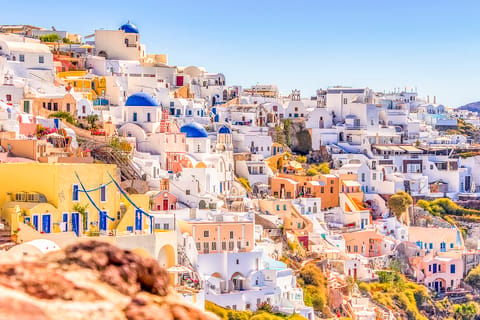
Discover the must-see spots of Santorini on this guided day trip. Admire panoramic views of the caldera, explore Perissa Beach, and watch an unforgettable sunset.

Classic Tour (5.5h): Explore Oia’s blue domes, the island’s highest peak, and Pyrgos, with an optional wine tasting. Full-Day Tour (7h): Add Akrotiri Excavations, Red ...

Taste the island's viniculture by joining the Sip of Santorini Wine Tour. Have an exclusive look at 2 different local wineries, including approximately 8 samples, befo...
Peak wine-travel season in Santorini is spring through autumn, with harvest the standout window.
classified-growth and grand-cru estates require booking days to weeks ahead; smaller family domaines often take walk-ins midweek.
most estates open 10:00 to 17:00 by appointment, often closed Sunday and Monday.
tipping is not expected at tastings; buying a bottle from the cellar door is the customary thank-you.
Ask the next local you meet what they would order. Santorini rewards trust.