Key eras
Roman viticulture at Augusta Treverorum
1st to 4th century AD
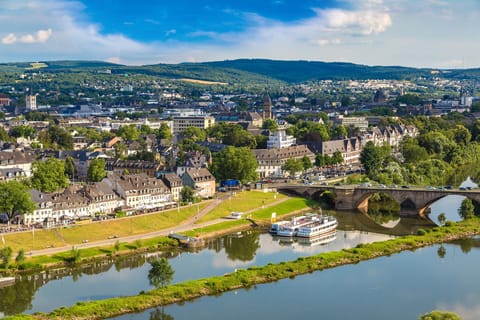
Rome founded Augusta Treverorum, modern Trier, around 16 BC and turned the steep Mosel valley into a serious wine frontier. The poet Ausonius praised the river's terraced vines in his Mosella in the 4th century, and Roman presses and villa estates spread along both banks.
Trier tourism and regional history pages document Roman-era viticulture around Augusta Treverorum and Ausonius' 4th-century poem Mosella praising the Mosel vineyards.
The Neumagen wine ship, around 220 AD
around 220 AD
A carved stone relief of a Roman river barge laden with wine barrels was found in 1878 in the tomb of a wine merchant at Neumagen, a village whose Roman-era viticulture is documented from the 2nd century AD. The Neumagener Weinschiff is held at the Rheinisches Landesmuseum Trier and inspired the modern Stella Noviomagi seagoing replica.
VisitMosel and Wines of Germany document the around 220 AD funerary relief found at Neumagen-Dhron and the modern Stella Noviomagi replica built from it.
Monastic and episcopal estates
7th to 12th century
After Rome, the Church carried Mosel viticulture forward. A 633 deed records the Trier Benedictine abbey of St Maximin holding vineyards at Mertesdorf, the core of today's Maximin Gruenhaus, and bishops and abbeys clad the best slate slopes in vines through the Middle Ages.
Maximin Gruenhaus and the VDP estate page document the 633 St Maximin abbey deed and centuries of monastic ownership at Mertesdorf in the Ruwer.
Vereinigte Hospitien charity cellars
13th century to present
Trier's charitable foundations built some of the oldest working wine cellars in Germany. The Vereinigte Hospitien cellars sit on Roman foundations under the city and still age Riesling, funding hospital and care work, a thread of charitable viticulture unbroken for centuries.
Trier tourism pages and the foundation's own history document the Roman-founded charity cellars under Trier that still produce and age Mosel Riesling.
Bischoefliche Weingueter Trier
1966 to present
Three church-linked estates, the cathedral chapter, the seminary and the orphanage foundation, merged into the Bischoefliche Weingueter Trier in 1966, pooling prime Mosel, Saar and Ruwer slate sites into one of the region's largest quality producers and a living link to its episcopal wine past.
The estate's own history and Trier wine pages document the 1966 merger of the cathedral, seminary and orphanage estates into the Bischoefliche Weingueter Trier.
Slate terroir and the Steillage tradition
Roman era to present
Mosel identity is built on blue and grey Devonian slate and on Steillage, vines on slopes often steeper than 30 degrees worked entirely by hand.
VisitMosel and viticulture references document the slate soils, hand-worked steep slopes and the Calmont as one of Europe's steepest vineyards.
The Praedikat sweetness tradition
18th to 20th century
The Mosel built its global fame on ripeness-graded Praedikat wines: Kabinett, Spaetlese, Auslese, Beerenauslese, Trockenbeerenauslese and Eiswein.
Mosel and German-wine references document the Praedikat ripeness ladder from Kabinett through Trockenbeerenauslese and Eiswein as the historic backbone of Mosel fame.
The Wehlener Sonnenuhr and the sundial sites
1842 onward
In 1842 the grower Jodocus Pruem had a stone sundial built into the steep slope above Wehlen so pickers could read the time from the vineyards.
Producer and regional pages document the 1842 Wehlener Sonnenuhr sundial built by Jodocus Pruem and the renown of the site.
The 1971 German Wine Law
1971
The 1971 German Wine Law reorganised vineyard naming, bundling many small historic sites into larger collective Grosslagen. It made labels easier to sell but blurred the link between a name and a single slope, diluting some of the Mosel's most storied vineyard identities for decades.
German-wine references document the 1971 Wine Law and its consolidation of vineyard sites into Grosslagen that diluted single-site names.
Phylloxera and the bulk-wine slump
1890s to 1980s
Phylloxera reached the Mosel late in the 19th century, and the 20th brought a long drift toward cheap sweet bulk blends. Liebfraumilch and sugary export wines dragged the region's reputation down even as its finest steep sites still made extraordinary Riesling.
German-wine histories document the phylloxera arrival and the 20th-century slide into cheap sweetened bulk wine that hurt the Mosel's image.
The VDP and the late-century quality revival
1980s to 2000s
From the 1980s a new generation of growers, backed by the VDP association of top estates, turned away from bulk sugar toward site-driven Riesling.
The VDP estate pages and producer histories document the late-20th-century quality revival and the VDP vineyard classification topped by Grosse Lage.
The dry-Riesling and Grosses Gewaechs movement
2000s to present
Warmer vintages and shifting tastes pushed the Mosel toward serious dry Riesling. The VDP's Grosses Gewaechs, the top dry bottling from a Grosse Lage, gave growers like Heymann-Loewenstein and Clemens Busch a frame for powerful, mineral, fully dry wines that now sit beside the classic Kabinett.
VDP and producer pages document the rise of fully dry Grosses Gewaechs Riesling from Grosse Lage sites in the modern Mosel.
The Terrassenmosel revival
1980s to present
On the lower Mosel near Winningen, terraced slate sites once written off as unworkable were rebuilt into the Terrassenmosel, where Heymann-Loewenstein and others proved that dry Riesling from these dramatic rock terraces could rank among Germany's greatest whites.
Producer and regional pages document the modern revival of the terraced lower-Mosel sites around Winningen as the Terrassenmosel.
The biodynamic and natural turn
1990s to present
A wave of Mosel growers moved to organic and biodynamic farming, with Clemens Busch fully biodynamic from 2005 and Melsheimer Demeter-certified from 2013, while natural-wine pioneers like Rudolf Trossen pushed minimal-intervention slate Riesling onto the world's natural-wine lists.
Producer pages document Clemens Busch's 2005 biodynamic conversion, Melsheimer's 2013 Demeter certification and Trossen's natural-wine work.
The steep-slope abandonment crisis
1990s to present
Steep Mosel vineyards cost three to five times more to farm than flat land, and as growers aged out many terraces were abandoned and reverted to scrub. The loss of these hand-worked Steillagen is the central conservation worry of the modern Mosel.
Regional and producer references document the high labour cost of steep Mosel sites and the ongoing abandonment of Steillage terraces.
The Mosel Riesling renaissance
2000s to present
Driven by cult demand for both featherweight Kabinett and powerful Grosses Gewaechs, the Mosel reclaimed its place among the world's elite white-wine regions.
Producer pages and recent guide ratings document the contemporary Mosel Riesling renaissance led by revived estates and old-vine slate sites.