La Meiro, Terre di Castelmagno
Farm at 1,700 m in the upper Valle Grana making Castelmagno DOP (Montagna and Alpeggio), aged in tufa caves. Its locanda serves it at several ageings and has rooms; opening is seasonal.

Cheese · DOP · Piedmont
A semi-hard cow's milk cheese from Three communes of Cuneo province: Castelmagno, Pradleves and Monterosso Grana.
A raw-milk cheese of the high Grana valley, made from whole cow's milk with a small share (5 to 20 per cent) of part-skimmed sheep or goat milk. The curd rests at least 18 hours, is soaked in whey for two to four days, then broken, salted and pressed. Qualigeo says the first wheels date to the twelfth century. Two versions exist: Prodotto di Montagna, from pastures at 600 to 1,000 m, and di Alpeggio, above 1,000 m from May to the end of October. Wheels are 15 to 25 cm across, 12 to 20 cm high and 2 to 7 kg.
Made in: Three communes of Cuneo province: Castelmagno, Pradleves and Monterosso Grana
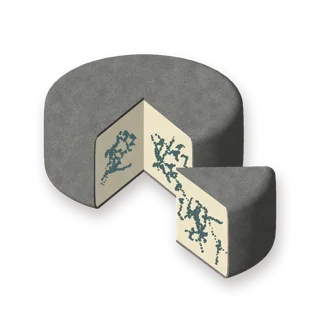
Very crumbly and without eyes. Mild when young, savoury and piquant when aged, when blue-green veins appear. The veining develops on its own with ageing, with no mould inoculated.
Rind: natural crust
Wine and cheese
Qualigeo pairs Castelmagno with full-bodied reds. The crumbly, piquant paste of an aged wheel, with its blue-green veins, meets Barolo's firm tannin and high acidity, which clear the palate between pieces.
Barbaresco is the kind of full-bodied red Qualigeo suggests for Castelmagno. Nebbiolo's firm tannin and high acidity cut through the crumbly, piquant paste of an aged wheel and keep its salty, savoury edge in view.
The grapes behind these winesNebbiolo
From the source
Farm at 1,700 m in the upper Valle Grana making Castelmagno DOP (Montagna and Alpeggio), aged in tufa caves. Its locanda serves it at several ageings and has rooms; opening is seasonal.
Alpine hamlet above 1,000 m where Beppino Occelli ages cheeses from its Farigliano dairy, and Castelmagno DOP di Alpeggio, in rock cellars on shelves of twelve woods. Shop and booked cellar visits.
Four-generation family cheese shop in the historic centre of Bra, working as an affineur with its own ageing cells and cellar. It favours raw-milk cheeses and small producers.
Turin dairy shop three minutes from Piazza Castello, taken over in 1958 by Romola and her sisters Marta and Bruna and run by her granddaughter Chiara since 2016. It sells Piedmontese specialities and DOP cheeses, and hosts booked tastings in the shop.
Cheese and wine shop under the arcades of Corso Vinzaglio since 1927, known for Piedmontese cheeses such as Castelmagno, Raschera and robiola, alongside Italian and foreign ones.
Slow Food's biennial fair of raw-milk cheeses fills the centre of Bra with artisan producers, tastings, workshops and talks. The 2025 edition was the fifteenth.
Guided walk through the shop's cold counter, workshop, ageing rooms and the ageing cellar, which holds a small cheese museum, then a tasting in a dedicated room. For larger summer groups a tent can be set up in the courtyard. Contact the shop to reserve.
The farm's locanda serves Castelmagno in its different types and ageings, and gnocchi al Castelmagno are always on the daily menu, in the valley where the cheese is made. Opening is seasonal.
Cellar visits and a guided tasting route at the Arona ageing house, by reservation. Private tastings in dedicated rooms pair its cheeses with bread and wine; English-language visits are available on booking.
Booked visit to the rock cellars of an alpine hamlet where cheeses rest on twelve kinds of wood, with a company shop on site. Cheeses include Castelmagno di Alpeggio and the Cusiè range.
Shop tasting of boards of cheeses and cured meats with handmade bread, grissini rubatà and a glass of wine, with panna and zabaione as an option. Book at least a day ahead.
Not by design. Qualigeo says the blue-green veining develops naturally in the more aged wheels, without inoculating any mould.
At least 60 days under the specification, in cool, humid rooms, according to Qualigeo.
Qualigeo suggests honey and jams at the table, polenta, risotto and beef carpaccio in the kitchen, and full-bodied red wines.
Italy recognised Castelmagno as a denominazione di origine by presidential decree on 16 December 1982, and the EU registered it as a DOP in 1996.
Same cheeseboard
Plan the trip
Tastings and tours where it is made, and somewhere to stay.
Booking links go to our partners (GetYourGuide, Viator, Zen Hotels), who may pay us a commission. It never decides what we cover. Editorial standards.
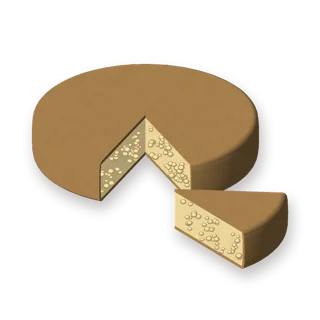
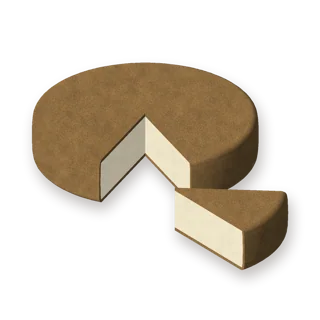
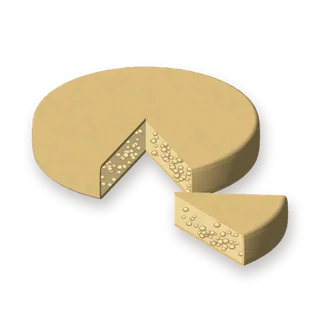
Sources: protection register, www.qualigeo.eu, it.wikipedia.org. The drawing is made from the cheese's recorded shape, rind and paste, not a photograph.