DOP, first protected 1978Cow milk, bothSemi, hardNatural rindAlso Asiago DOP Fresco
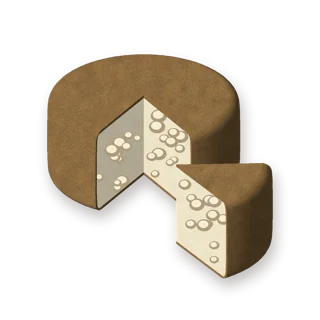
The fresh, whole-milk side of Asiago DOP, known on the label as Fresco and in the trade as Pressato because the curd is pressed for up to twelve hours. The semi-cooked curd is made from raw, thermised or pasteurised cow's milk and ripens for at least 20 days. Qualigeo notes that this fresh type only began to be made in the 1920s; the older aged cheese came first. The EU specification gives wheels 30 to 40 cm across, 11 to 15 cm high and 11 to 15 kg.
Taste: Sweet and slightly tangy, recalling yogurt, butter and milk, per the consortium. Qualigeo describes a thin elastic rind and a white to lightly straw paste with marked, irregular eyes; Italian Wikipedia calls the paste soft and buttery.
Ageing: 20 days minimum (30 for Prodotto di Montagna); Riserva above 40 days
Made in: Province of Vicenza, parts of Padova and Treviso, and the autonomous province of Trento
DOP, first protected 1978Cow milk, bothHardNatural rindAlso Asiago DOP Stagionato
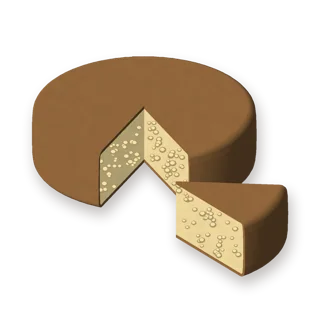
The older of the two Asiago types, labelled Stagionato or d'Allevo. It is made from partly skimmed cow's milk, raw or thermised, and ripens for at least 90 days inside the production zone. Qualigeo traces the cheese to the plateau of the Seven Communes, where sheep's-milk cheese was made around the year 1000 and cattle replaced sheep by the sixteenth century. The EU specification gives wheels 30 to 36 cm across, 9 to 12 cm high and 8 to 12 kg.
Taste: More decided than the fresh type. Qualigeo describes a compact paste from straw to amber with scattered eyes. The consortium says Mezzano is compact with sweet notes, while Vecchio and Stravecchio turn crumbly and grainy, savoury and persistent.
Ageing: 90 days minimum; Mezzano 4 to 10 months, Vecchio 10 to 15 months, Stravecchio over 15 months
Made in: Province of Vicenza, parts of Padova and Treviso, and the autonomous province of Trento
DOP, first protected 1993Cow milkSemi, hardNatural rind
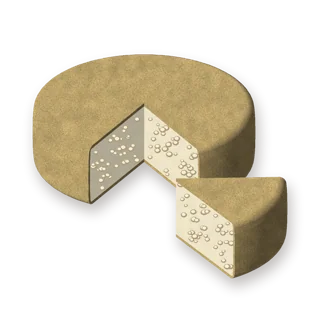
A semi-cooked cow's-milk cheese of the Verona mountains, made in two types: Latte Intero from whole milk and d'Allevo from partly skimmed milk. Qualigeo traces it to the thirteenth century, when Cimbrian settlers from the Asiago plateau began making cheese in the Verona mountains; the consortium specification gives wheels of 25 to 35 cm across, 6 to 11 cm high and 6 to 10 kg. A Di Malga version from alpine pasture milk is a Slow Food Presidium.
Taste: Latte Intero is pleasant and delicate with a thin straw-coloured rind and fine, evenly spread eyes. D'Allevo has scattered eyes and a fragrant flavour that turns slightly piquant with age, per Qualigeo.
Ageing: Latte Intero marketable from 25 days; d'Allevo from 3 months and up to 2 years
Made in: Communes of the northern part of the province of Verona (Lessinia and Monte Baldo)

DOP, first protected 2010Cow milkHardNatural rind
A hard cow's-milk cheese made only in the province of Belluno, in the Dolomites. At least 80 per cent of the milk comes from Italian Brown, Grey Alpine, Red Pied and Friesian cows kept in the zone, and the starters are made from raw milk. Qualigeo links its history to the first cooperative village dairies (latterie turnarie) of the nineteenth century. The consortium gives wheels 27 to 32 cm across and 7 to 8 cm high, from about 7 kg when fresh to 5.5 kg for Riserva.
Taste: Sweet and milky when fresh, then increasingly savoury and intense with age, but never spicy, per Qualigeo. The consortium adds an aroma of alpine herbs and flowers; aged wheels turn golden and crumbly and are grated.
Ageing: Fresco 20 to 60 days; Mezzano 61 to 180 days; Vecchio over 180 days; Selezione Oro over 12 months; Riserva over 18 months
Made in: The whole province of Belluno

DOP, first protected 1986Cow milk, bothHardNatural rind
A cooked, hard cow's-milk cheese shared between Friuli and Veneto: the specification covers the whole of Friuli Venezia Giulia plus the Veneto provinces of Belluno and Treviso and parts of Padova and Venezia. Qualigeo traces it to the thirteenth century, when the monks of the abbey of Moggio Udinese refined the cheese of the Montasio mountain pastures. The milk may be thermised but not pasteurised. Whole wheels weigh 5.5 to 8 kg, 27 to 35 cm across and at most 8 cm high.
Taste: Milky, soft and delicate when fresh; full and decided as Mezzano; savoury and aromatic as Stagionato; and notably full-bodied as Stravecchio, per Qualigeo. The paste is straw yellow with slight eyes and turns granular with age.
Ageing: 60 days minimum; Fresco 2 to 4 months, Mezzano 4 to 10, Stagionato over 10, Stravecchio over 18 months
Made in: All of Friuli Venezia Giulia, the provinces of Belluno and Treviso and part of Padova and Venezia (Veneto)

DOP, first protected 2008Cow milkFresh
A soft fresh cheese of the Marca Trevigiana made from whole cow's milk of specified Italian breeds. It is moulded in cylinders, salted and ripened only 4 to 8 days. Two sizes exist: the small form is 5 to 12 cm across and 200 to 700 g, the large 18 to 22 cm and 1.8 to 2.2 kg. Qualigeo finds written evidence from the seventeenth century, and a gift of 24 forms to the Doge in 1789.
Taste: A soft paste with a delicate scent and a sweet taste, and no rind or one barely perceptible, per Qualigeo. It suggests grilled Radicchio Rosso di Treviso, polenta, or fruit mostarda.
Ageing: 4 to 8 days in moulds at 2 to 8 C
Made in: The whole province of Treviso

DOP, first protected 1955Cow milkHardNatural rind
A hard, cooked, slow-ripening cow's-milk cheese made across the Po Valley. In Veneto the zone covers Padova, Rovigo, Treviso, Venezia, Verona and Vicenza, so Veneto dairies in the Lessinia and the Colli Berici make it alongside their local cheeses. The cheese is a shared one, not Veneto's alone. Qualigeo traces it to Cistercian monks around the year 1000. The milk is partly skimmed by natural creaming and cooked in copper vats; Italian Wikipedia says a finished wheel must weigh 24 to 40 kg, and it ages at least nine months.
Taste: Fine, granular paste, white to straw coloured, with barely visible eyes, a fragrant aroma and a delicate flavour, per Qualigeo. It is used both as a table cheese and grated.
Ageing: 9 months minimum, up to over 20 months; Riserva over 20 and over 24 months
Made in: A large part of the Po Valley, in Veneto the provinces of Padova, Rovigo, Treviso, Venezia, Verona and Vicenza

DOP, first protected 1993Cow milkPasta, filataNatural rind
A semi-hard stretched-curd (pasta filata) cow's-milk cheese made in two types, Dolce with calf rennet and Piccante with lamb or kid rennet. The zone is mostly Lombard, but includes the Veneto provinces of Verona, Vicenza, Padova and Rovigo. It is shared, not Veneto's alone. Italian Wikipedia says weights run from a few hundred grams to over 100 kg depending on shape and ageing. Qualigeo says the shape may be salami, truncated cone, melon or pear, optionally topped with a small ball.
Taste: Mild in the Dolce type, more decided in the Piccante, per Qualigeo; the paste is compact, straw yellow, with the odd slight eye, under a thin smooth rind from pale to golden yellow, sometimes brownish. It can be smoked.
Ageing: From 10 days (smallest) to 30 days (medium) to at least 90 days (largest and Piccante)
Made in: Cremona, Brescia and parts of Bergamo, Mantova and Lodi; Verona, Vicenza, Padova and Rovigo in Veneto; parts of Trento; Piacenza
Cow milkSemi, softAlso Morlacco
A tender, lean, raw-paste cow's-milk cheese of the Monte Grappa pastures, named, per Italian Wikipedia, for the Morlacchi, an ancient people of the Dinaric Alps. It is not a DOP; Italian Wikipedia lists it as a traditional agri-food product and Slow Food protects the alpine version as a Presidium. On the summer pastures the evening milk is skimmed by creaming and mixed with the whole morning milk, heated to 38 to 42 C and set with calf rennet, and the wheels are salted for 12 days; this malga cheese is made June to September, while dairies on the plain make it from pasteurised milk.
Taste: Tender but not soft, clean when cut, with weeping eyes and a very salty flavour that softens with age, giving way to pasture and hazelnut notes, per Slow Food. Traditionally eaten with polenta, boiled potatoes or bread.
Ageing: On sale at 15 days; eaten up to 3 months
Made in: Monte Grappa massif (provinces of Treviso, Belluno and Vicenza)

Cow milkFresh
A very fresh cheese of the Belluno mountains, born in the alpine huts from the curd of just-milked cow's milk. It is not a DOP; Italian Wikipedia lists it as a traditional agri-food product (PAT). Lattebusche, which makes it today, derives the name from the dialect schizar, either for the curd that spurted from the moulds or for the whey droplets that spurt while it cooks; Wikipedia gives the second. It is browned in butter in a pan, then finished with cream or milk, and eaten with polenta.
Taste: A compact paste of a brilliant white with an intense smell of milk, per Lattebusche. It is browned in butter and finished with cream or milk, and polenta is the characteristic partner.
Ageing: Eaten fresh
Made in: Province of Belluno