DOP, first protected 1955Cow milk, rawHardNatural rind
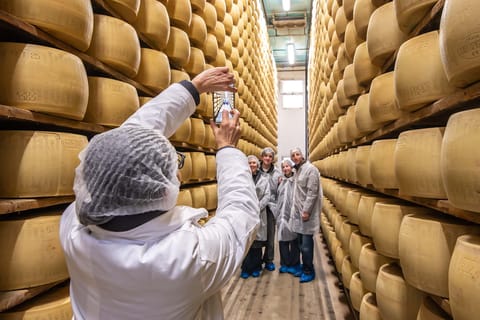
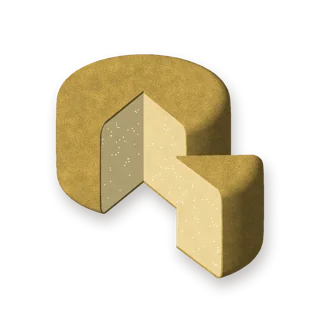
The hard, long-aged cheese of Parma, Reggio Emilia, Modena, Bologna west of the Reno and Mantova south of the Po. It is made from raw cow's milk, evening and morning milkings combined, with no additives, then salted and aged for at least 12 months, some wheels well past 60. Qualigeo dates its first written trace to 1254 as caseus parmensis, and Boccaccio's Decameron already knows it grated. Wheels run 35 to 43 cm across and 20 to 26 cm high, at least 30 kg, averaging 40 to 42 kg; it has been a protected Italian denomination of origin since 1955 and an EU PDO since 1996.
Taste: Delicate and fragrant, tasty but not spicy, says Qualigeo. The paste is hard, finely granular and flakes when broken. The consortium's sensory guide finds milk, yogurt and fresh fruit at 12 to 18 months, dried fruit and broth around 30 to 36, spice beyond 40, with white tyrosine crystals as the mark of age.
Ageing: 12 months minimum, commonly 24 to 36, some beyond 60
Made in: Provinces of Parma, Reggio Emilia, Modena, Bologna (west of the Reno) and Mantova (south of the Po)
DOP, first protected 1955Cow milkHardNatural rind
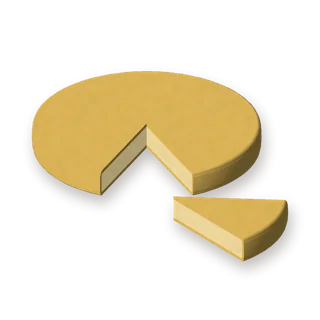
A hard, grainy cheese of the Po Valley whose production zone, according to Qualigeo, reaches into Emilia-Romagna: Piacenza, Ferrara, Ravenna, Forli-Cesena, Rimini and the part of Bologna east of the Reno. The milk comes from cows milked twice a day and fed on forage from the zone. Wheels are aged at least nine months, with some Riserva above 20. Qualigeo traces it to Cistercian monks around the year 1000; a presidential decree of 30 October 1955 first recognised it as a denomination of origin, and it has been an EU PDO since 1996. The consortium gives wheels 35 to 45 cm across, 18 to 25 cm high and 24 to 40 kg.
Taste: Fragrant aroma and delicate flavour, says Qualigeo. The paste is hard and finely granular, straw yellow or white, with a radial flaky fracture and barely visible eyes; the rind is thick, smooth and golden.
Ageing: 9 months minimum, some over 20 months
Made in: A wide Po Valley zone; in Emilia-Romagna the province of Piacenza and the parts of Bologna (east of the Reno), Ferrara, Forli-Cesena, Ravenna and Rimini that the specification lists
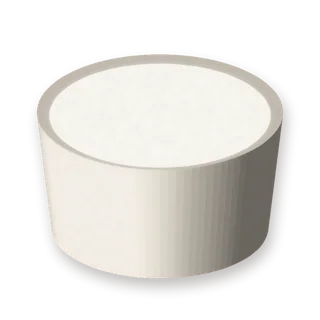
DOP, first protected 2012Cow milk, bothFresh
A very soft, spreadable cow's milk cheese of Romagna, made from whole milk that is pasteurised or thermised and eaten within days. The name comes from the dialect word for something that squashes into cream. It has no rind, a mother-of-pearl white paste and takes its shape from the container. The oldest document ONAF cites is a letter of the Bishop of Cesena, Cardinal Bellisomi, of 15 February 1800. It became an EU PDO in 2012 (Reg. UE 679/2012). It is classically spread on warm piadina.
Taste: Sweet with a touch of acidity, the salt present but not obvious; the aroma is delicate and milky with a grassy note, according to the national cheese tasters' organisation ONAF. The paste is soft, creamy and highly spreadable.
Ageing: None; ripens for a few days at most (1 to 4 days per Qualigeo)
Made in: Provinces of Ravenna, Forli-Cesena, Rimini and Bologna, and part of Ferrara (east of the SS 64 Porrettana and south of the Po)
DOP, first protected 2009Cow and sheep milkSemi, hardAlso Fossa di Sogliano
A cheese ripened in sandstone pits dug into the ground, a practice Qualigeo dates to the Middle Ages, with the first written record of the techniques in the Malatesta family archives of the 14th century. Cow's milk, sheep's milk or a blend (at least 20 percent sheep's milk) is first aged for 60 to 240 days, then buried for 80 to 100 days. Pieces are irregular, 500 to 1,900 g, with almost no rind. The protected name carries the name of Sogliano al Rubicone; the cheese was registered as an EU PDO in December 2009.
Taste: Very strong aroma with notes of sulphur, mould and truffle. The sheep's milk version is aromatic, intense and slightly spicy; the cow's milk version milder, lightly acidic and salty with a bitter finish. The paste is semi-hard and crumbles easily, white-amber to straw.
Ageing: Pre-aged 60 to 240 days, then 80 to 100 days in a pit
Made in: Provinces of Forli-Cesena, Rimini, Ravenna and part of Bologna, plus districts of the Marche (Ancona, Macerata, Pesaro-Urbino, Ascoli Piceno)
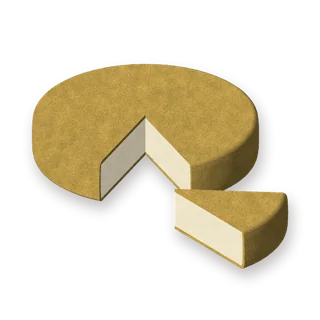
Cow milkSemi, softNatural rind
A small, mild table cheese made in many Italian regions. Italian Wikipedia says Emilia-Romagna counts a caciotta and a cow's milk caciotta made with vegetable rennet among its traditional agri-food products (PAT), which is a regional list and not a protected name. In the region dairies such as Rosola in the Modena hills and Lucchesi near Bologna list caciotte among their everyday cheeses, and caciotta turns up in dairy tastings.
Taste: Caciotte are generally delicate in flavour, with a soft white to yellowish paste under a soft yellow rind, according to Italian Wikipedia, which gives no details for the regional varieties.
Made in: Emilia-Romagna, where the region lists a caciotta and a cow's milk caciotta made with vegetable rennet among its traditional agri-food products
Cow milkWhey
Ricotta is made from the whey left after cheesemaking and is classed in law as a dairy product rather than a cheese; it may come from cow, sheep, goat or buffalo milk. Drained in perforated baskets, it is sweet and soft. In Emilia-Romagna it is the base of fillings for pasta such as the cappelletti of Romagna, and dairies sell it daily: Rosola lists a Ricotta di Bianca Modenese, Lucchesi near Bologna makes several, and dairy tastings often include it with balsamic vinegar.
Taste: Sweet from 2 to 4 percent lactose, according to Italian Wikipedia, which adds that sheep's milk ricotta has the most intense flavour and the highest fat, around 24 percent against about 8 percent for cow.
Made in: Made across Emilia-Romagna by its dairies