Key eras
Roman viticulture in the Rhine bend
1st to 4th century AD
Roman legions stationed at Mogontiacum (modern Mainz) planted vines on loess and limestone slopes around what is now Worms, Bingen and the Rhine terrace. Archaeological finds document organised wine growing across the Rhine bend long before the medieval monastic era.
The Deutsches Weininstitut and the Wikipedia article on Rheinhessen wine region document Roman-era viticulture on the Rhine slopes that became modern Rheinhessen.
Liebfraumilch and the Wormser Liebfrauenkirche
1296 to 1744
Vineyards adjoining the Liebfrauenkirche church in Worms, planted from around 1296 under the canons of the chapter, lent their name to the Liebfraumilch wine. The name first appears in the late 18th century and ultimately became the world-export Rheinhessen brand for sweet Riesling-led blends.
Wikipedia articles on Liebfraumilch and on the Wormser Liebfrauenkirche document the church-vineyard origin of the Liebfraumilch name.
Rheinhessen placed under the Grand Duchy of Hesse, 1816
1816
After the Congress of Vienna, in 1816 the left-bank territory between Mainz, Worms, Alzey and Bingen was assigned to the Grand Duchy of Hesse-Darmstadt as Rheinhessen. The new administration mapped, taxed and classified vineyards across the region, beginning a century of structural reform that shaped the modern province.
Wikipedia articles on Rheinhessen and on the Grand Duchy of Hesse document the 1816 transfer of the territory after the Congress of Vienna.
Phylloxera reaches Rheinhessen, 1880s
1880s to early 1900s
Phylloxera reached Rheinhessen vineyards in the 1880s, devastating ungrafted vines across the Rhine terrace. Replanting on American rootstock through the early 20th century reset the vineyard map, with a handful of ungrafted Wurzelecht parcels surviving at Gunderloch's Rothenberg in Nackenheim.
The Deutsches Weininstitut and Wikipedia document the European phylloxera outbreak that reached German regions including Rheinhessen in the 1880s.
Mueller-Thurgau and the postwar volume era
1950s to 1980s
Through the postwar decades Mueller-Thurgau planted widely across Rheinhessen's rolling Hauptanbaugebiet, with high-yield cooperative production driving the late-century Liebfraumilch export boom. By the 1980s Rheinhessen was Germany's quantitative volume centre, with quality reputation lagging behind the Mosel and Rheingau.
The Deutsches Weininstitut and Wikipedia regional pages document Mueller-Thurgau's dominance in Rheinhessen through the postwar volume era.
The 1971 German Wine Law and the Bereich system
1971
The 1971 German Wine Law restructured every German wine region. Rheinhessen was divided into three Bereiche of Bingen, Nierstein and Wonnegau, 24 Grosslagen and 414 Einzellagen, and the old tax-class hierarchy was replaced with a national Praedikat ladder keyed to must-weight rather than vineyard quality.
Wikipedia and VDP publications document the 1971 restructuring of German wine law and the resulting Bereich, Grosslage and Einzellage framework that still governs Rheinhessen.
Rheinhessen-Fuenf and the quality revolt, late 1980s
late 1980s
In the late 1980s a group of Rheinhessen growers including Gunderloch in Nackenheim began rejecting the bulk-Liebfraumilch model and refocusing on single-vineyard dry Riesling. The Rheinhessen-Fuenf alliance and the parallel Message in a Bottle initiative were the first public quality revolts against the regional reputation.
The VDP Rheinhessen pages and the German Wine Institute document the late-1980s quality-revival movement among Rheinhessen growers.
Message in a Bottle generation, 1990s onward
1990s onward
Through the 1990s a young Rheinhessen generation built the Message in a Bottle marketing collective. Klaus-Peter Keller at Floersheim-Dalsheim, Philipp Wittmann at Westhofen and Daniel Wagner at Siefersheim built international reputations on dry Riesling from limestone Wonnegau and Siefersheim porphyry sites, resetting the regional image.
The Wikipedia article on Rheinhessen wine region and the VDP Rheinhessen pages document the rise of the Message in a Bottle generation in the 1990s.
VDP Grosses Gewaechs and the Rheinhessen Grosse Lage map, 2002
2002
In 2002 the VDP introduced Grosses Gewaechs nationally, a dry top-tier bottling from classified Grosse Lage sites. In Rheinhessen the GG framework formalised Westhofener Morstein, Kirchspiel, Brunnenhaeuschen and Aulerde, Floersheim-Dalsheimer Hubacker and Buergel, Niersteiner Pettenthal and Hipping and Nackenheimer Rothenberg as bench reference sites.
Wikipedia and the VDP website document the 2002 launch of the national Grosses Gewaechs classification and the Rheinhessen Grosse Lage map.
Roter Hang biodynamic shift, 2010s
2010 onward
Through the 2010s biodynamic farming spread across the Roter Hang under Kai Schaetzel at Nierstein (Demeter-certified) and Carolin Spanier-Gillot at Kuehling-Gillot in Bodenheim (La Renaissance des Appellations). St. Antony followed under the Meyer family ownership, with Pettenthal, Hipping and Oelberg parcels taken to Demeter certification.
The VDP Rheinhessen pages, the Demeter Germany registry and producer history pages document the 2010s biodynamic conversion at Schaetzel, St. Antony and Kuehling-Gillot.
Mainz joins the Great Wine Capitals network, 2018
2018
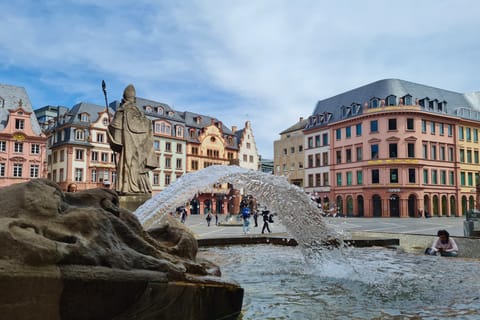
In 2018 Mainz formally joined the Great Wine Capitals Global Network as the German member, alongside Bordeaux, Porto, Mendoza, Verona, San Francisco-Napa, Adelaide, Bilbao-Rioja, Lausanne and Cape Town. The accession recognised Rheinhessen's modern quality position and Mainz's role as the regional consortium capital.
The Great Wine Capitals Global Network and the Stadt Mainz tourism pages document the 2018 entry of Mainz as the German member city.
G-Max and the Rheinhessen secondary market, 2020s
2020 onward
Through the 2020s Klaus-Peter Keller's G-Max Riesling, a micro-cuvee from Floersheim-Dalsheim, has consistently traded among the most expensive German dry Rieslings on the secondary market. Wittmann's Morstein GG and Battenfeld-Spanier's Frauenberg CHF Riesling sit in the same tier on Liv-ex and Wine-Searcher listings.
Wine-Searcher, Liv-ex digests and German wine-trade press document the secondary-market position of Keller G-Max and Wonnegau Grosses Gewaechs through the early 2020s.