Lyon is the natural base and launch point for the entire Rhone Valley wine corridor. From Lyon, the northern Rhone appellations of Cote-Rotie (Ampuis, 30 km south) and Condrieu are a short drive or train ride away.
Pours: Cotes du Rhone by the glass in Lyon bouchons, Condrieu at La Mere Brazier wine cellar, Saint-Joseph rouge at Lyon wine bars
Tip: Take the Rhone Expres tram from Lyon Part-Dieu to the airport and then rent a car to reach Ampuis and Condrieu in under 40 minutes. The Vieux-Lyon quarter's bouchons pour Cotes du Rhone and Saint-Joseph by the pichet.
The Beaujolais cru region begins just 15 km north of Lyon and is one of the most instructive half-day excursions from the northern Rhone. The 10 Beaujolais crus, all Gamay, contrast vividly with the Syrah-dominant northern Rhone: lighter body, higher acidity, and granite-mineral character in Morgan and Moulin-a-Vent. The region's natural-wine movement (Jean Foillard, Marcel Lapierre) has revitalised the crus' reputation. Beaujolais is a direct complement to, not a substitute for, a Rhone itinerary.
Pours: Moulin-a-Vent cru Gamay, Fleurie cru Beaujolais, Morgan cru Beaujolais
Tip: The cave cooperative at Beaujeu offers a structured tasting of all 10 crus. Jean Foillard in Morgan is open by appointment and a reference for low-intervention Gamay.
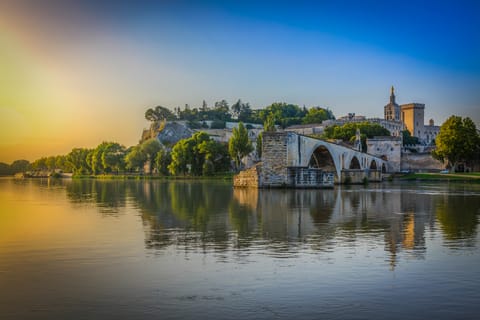
Avignon is the natural base for southern Rhone wine tourism and its own UNESCO-listed historic centre (Palais des Papes) is inseparable from the history of Chateauneuf-du-Pape.
Pours: Chateauneuf-du-Pape at Avignon wine bars, Cotes du Rhone Villages Laudun, Lirac blanc
Tip: The wine bar Les Halles inside the Avignon covered market offers a comprehensive southern Rhone tasting by the glass. Pair with regional charcuterie and tapenade.
The Roman theatre of Orange (UNESCO listed, 1st century AD) is the best-preserved ancient theatre in Europe and is 15 minutes from the Chateauneuf-du-Pape village.
Pours: Chateauneuf-du-Pape rouge at cellar doors, Chateauneuf-du-Pape blanc at Chateau Rayas cellar, Cotes du Rhone Villages Orange AOC
Tip: The Theatre Antique hosts the Choregies d'Orange opera festival each July. Pair a performance evening with a dinner in Chateauneuf the following day.
The Dentelles de Montmirail, a range of jagged limestone and sandstone peaks east of Orange, provide the most dramatic backdrop in the southern Rhone.
Pours: Gigondas AOC rouge vieilles vignes, Vacqueyras AOC rouge, Beaumes-de-Venise Muscat VDN
Tip: The GR hiking trail through the Dentelles is well-marked and manageable in 3-4 hours. Combine with a post-hike tasting at Domaine Santa Duc (book in advance) for a full day.
Vienne is the historic Roman colony of Vienna and the starting point of northern Rhone wine history. Its Roman amphitheatre (1st century BC) hosts the Jazz a Vienne summer festival, and the archaeological museum documents the region's ancient viticulture. Vienne is also the northern gateway to Condrieu AOC: the Viognier appellation begins just south of the city at Chavanay and Condrieu village, making a combined cultural-wine half-day natural.
Pours: Condrieu AOC Viognier, Cote-Rotie AOC rouge at Guigal, Vin de Vienne cuvee Ostia
Tip: Georges Vernay's Condrieu cellar, 12 km south of Vienne, can be visited by appointment. Combined with the Roman theatre and a lunch at La Pyramide (Michelin-starred, Vienne) this is one of the Rhone Valley's most complete cultural days.