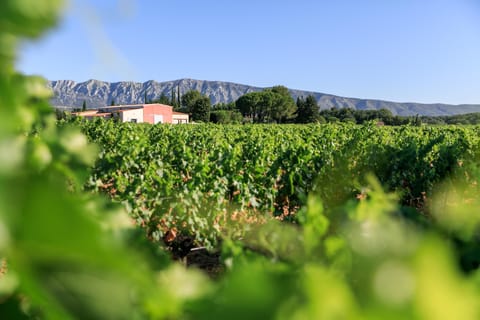
Just north of Provence, the southern Rhone opens at Chateauneuf-du-Pape with the famous galets roules and Grenache-led blends, then runs east through Gigondas to the rose-only village of Tavel.
Pours: Chateauneuf-du-Pape rouge, Chateauneuf-du-Pape blanc, Gigondas, Tavel rose
Tip: Start at the Chateau de Beaucastel cellar or the Vinadea consortium tasting room in Chateauneuf village; Tavel is the rose to drink against a Bandol rose for an instructive contrast.
West of the Rhone, Languedoc opens with Pic Saint-Loup north of Montpellier and the broader Languedoc-Roussillon stretching to the Pyrenees.
Pours: Pic Saint-Loup, Terrasses du Larzac, Faugeres, Languedoc-Roussillon rose
Tip: Pic Saint-Loup is the closest Languedoc cru to Provence and the easiest day-trip; Domaine de l'Hortus and Mas Bruguiere are the references.
Corsica is reachable by overnight ferry from Marseille, Toulon and Nice, and is the Mediterranean counterpoint to Provençal viticulture: native grapes (Niellucciu, Sciaccarellu, Vermentinu) on granite and limestone soils, with the Patrimonio reds and Ajaccio Sciaccarellu the canonical bottles.
Pours: Patrimonio Niellucciu, Ajaccio Sciaccarellu, Vin de Corse, Muscat du Cap Corse
Tip: Treat Corsica as a two-night trip rather than a day trip; the overnight ferry from Marseille or Toulon lands you near Patrimonio for a morning cellar visit and a full day in the vineyards.
Across the Italian border, Liguria runs along the coast from Ventimiglia to La Spezia. The Cinque Terre's cliff-edge terraces produce a saline coastal white from Bosco, Albarola and Vermentino, and Pigato is the local star of the Riviera di Ponente west of Genoa. The wines drink with the same seafood as Cassis Blanc but on a more aromatic register.
Pours: Cinque Terre Bianco, Sciacchetra (Cinque Terre passito), Pigato, Vermentino della Riviera Ligure di Ponente
Tip: The Cinque Terre is a UNESCO site rather than a fast cellar circuit; pair it with a Pigato producer on the Riviera di Ponente (around Albenga) for a structured tasting day.
Bellet is one of France's smallest AOCs, a sliver of vineyard tucked into the hills directly above Nice with around 50 hectares planted to the indigenous Folle Noire, Braquet and Rolle.
Pours: Bellet Rouge (Folle Noire and Braquet), Bellet Blanc (Rolle), Bellet Rose
Tip: Bellet sits within Nice city limits, twenty minutes from the centre. Start at Chateau de Bellet and Clos Saint Vincent; both pour the Braquet and Folle Noire reds.
The Luberon hills run east-west between the Durance and the Vaucluse plateau, with a cluster of estates including the Massot family at Chateau La Verrerie, Chateau Val Joanis and Chateau de Mille.
Pours: Luberon rouge, Luberon rose, Luberon Blanc (Vermentino)
Tip: Pair the cellar visits with a stop in one of the perched villages (Gordes, Lourmarin, Bonnieux) for a Sunday afternoon that mixes architecture and Luberon rose.