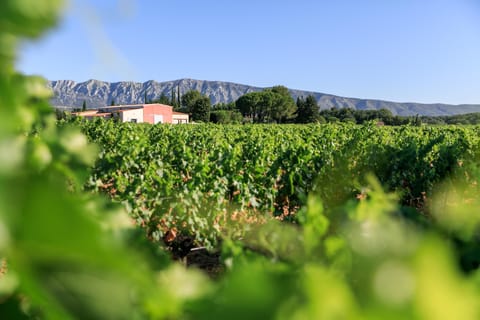
Bellet is one of France's smallest AOCs, a sliver of vineyard tucked into the hills directly above Nice with around 50 hectares planted to the indigenous Folle Noire, Braquet and Rolle.
Pours: Bellet Rouge (Folle Noire and Braquet), Bellet Blanc (Rolle), Bellet Rose
Tip: Bellet sits within Nice city limits, twenty minutes from the centre. Start at Chateau de Bellet and Clos Saint Vincent; both pour the Braquet and Folle Noire reds.
The Luberon hills run east-west between the Durance and the Vaucluse plateau, with a cluster of estates including the Massot family at Chateau La Verrerie, Chateau Val Joanis and Chateau de Mille.
Pours: Luberon rouge, Luberon rose, Luberon Blanc (Vermentino)
Tip: Pair the cellar visits with a stop in one of the perched villages (Gordes, Lourmarin, Bonnieux) for a Sunday afternoon that mixes architecture and Luberon rose.
Palette is a 50-hectare AOC just east of Aix-en-Provence, almost entirely worked by a handful of estates with Chateau Simone the historic reference.
Pours: Chateau Simone Palette rouge, Chateau Simone Palette rose, Chateau Simone Palette blanc
Tip: Chateau Simone is a working historic monument; ring ahead for a visit and pair the rare Palette blanc with grilled fish, the white that ages longest in Provence.
Just north of Provence, the southern Rhone opens at Chateauneuf-du-Pape with the famous galets roules and Grenache-led blends, then runs east through Gigondas to the rose-only village of Tavel.
Pours: Chateauneuf-du-Pape rouge, Chateauneuf-du-Pape blanc, Gigondas, Tavel rose
Tip: Start at the Chateau de Beaucastel cellar or the Vinadea consortium tasting room in Chateauneuf village; Tavel is the rose to drink against a Bandol rose for an instructive contrast.
West of the Rhone, Languedoc opens with Pic Saint-Loup north of Montpellier and the broader Languedoc-Roussillon stretching to the Pyrenees.
Pours: Pic Saint-Loup, Terrasses du Larzac, Faugeres, Languedoc-Roussillon rose
Tip: Pic Saint-Loup is the closest Languedoc cru to Provence and the easiest day-trip; Domaine de l'Hortus and Mas Bruguiere are the references.
Corsica is reachable by overnight ferry from Marseille, Toulon and Nice, and is the Mediterranean counterpoint to Provençal viticulture: native grapes (Niellucciu, Sciaccarellu, Vermentinu) on granite and limestone soils, with the Patrimonio reds and Ajaccio Sciaccarellu the canonical bottles.
Pours: Patrimonio Niellucciu, Ajaccio Sciaccarellu, Vin de Corse, Muscat du Cap Corse
Tip: Treat Corsica as a two-night trip rather than a day trip; the overnight ferry from Marseille or Toulon lands you near Patrimonio for a morning cellar visit and a full day in the vineyards.