AOP, first protected 2000Goat milk, rawSoft, bloomyNatural rind
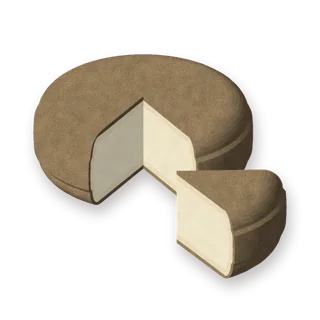
A small round cheese of raw whole goat's milk from the Cévennes and the departments of Gard, Hérault, Lozère and Aude, with a thin rind covered partly or wholly in pale yellow, white or blue moulds. The AOC decree dates from August 2000 and EU protection from 2001. The milk is curdled for at least 18 hours with very little rennet (no more than 1 ml per 10 litres), moulded by hand in faisselles, dry-salted and ripened for 11 days or more. A Languedoc dictionary of 1756 already described it as a small round flat cheese made in the Cévennes.
Taste: A smooth, even paste, white to ivory, with a small hazelnut taste; it turns brittle and the rind darkens as ripening goes on, according to French Wikipedia. The pairing guide accords-mets-vins.fr calls the texture crumbly and the taste frank, sometimes slightly spicy.
Ageing: At least 11 days at 8 to 16 °C and 85 to 95 percent humidity
Made in: About 500 communes, mostly in Gard, Hérault, Lozère and Aude, plus one commune in Tarn (Murat-sur-Vèbre)
AOP, first protected 1925Sheep milk, rawBlue
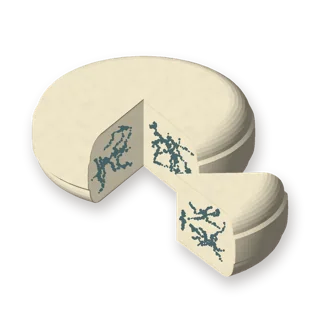
A raw Lacaune sheep's milk blue ripened only in the natural caves under the Combalou cliff at Roquefort-sur-Soulzon, where air moves through rock fissures called fleurines. The village is in Aveyron, beyond the Languedoc vineyards, but the milk-collection zone reaches Hérault, Gard and Aude, and the Hérault tourist board notes that the Lacaune ewes are raised on the Larzac. The law of 26 July 1925 made it the first French cheese to receive a protected appellation, according to French Wikipedia; it became an AOC in 1979 and an AOP in 1996. Letters patent of 1411 had already reserved its ripening to the village.
Taste: An ivory to cream paste marbled with grey, blue and green mould, its structure running from crumbly to creamy. French Wikipedia puts the best eating from April to October after about five months of ripening.
Ageing: At least 14 days in the natural caves of Roquefort-sur-Soulzon, then further maturation; about five months before the best eating
Made in: Milk from Lacaune ewes in six departments (Aveyron, Lozère, Tarn, Aude, Hérault, Gard); ripened only in the caves of Roquefort-sur-Soulzon, Aveyron
AOP, first protected 1979Cow milk, bothBlueNatural rind
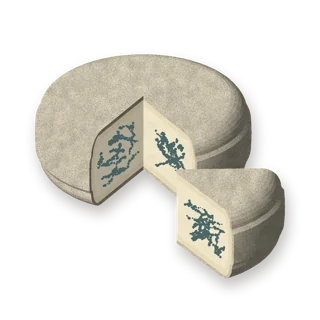
A cow's milk blue from the limestone Grands Causses, ripened in natural caves ventilated by fleurines, concentrated around Millau. Before 1925 such blues were made from cow's, ewe's or mixed milk; when Roquefort was recognised that year, cow's milk versions were excluded, and their makers built their own identity as Bleu de l'Aveyron, later renamed Bleu des Causses. Decrees of 1941 and 1946 laid the foundations of the appellation; the consortium and INAO date the AOC to 1979, and it became an AOP in 1996. Its area is mostly Aveyron, but the specification's area reaches into Hérault at Pégairolles-de-l'Escalette, north of Lodève.
Taste: The consortium describes a frank character and an intense creaminess: the assertive power of a veined paste with a distinctive finesse on the palate. It says the cheese goes well with dried fruit and unusual breads, and can be cooked with from aperitif to dessert.
Ageing: At least 70 days from renneting, ripened in natural fleurine caves of the Causses
Made in: Nearly all of Aveyron and parts of Lot, Lozère, Gard and Hérault; ripening only in caves of the Causses around Millau, Cornus, Campagnac, Peyreleau and Saint-Affrique, plus Trèves (Gard) and Pégairolles-de-l'Escalette (Hérault)
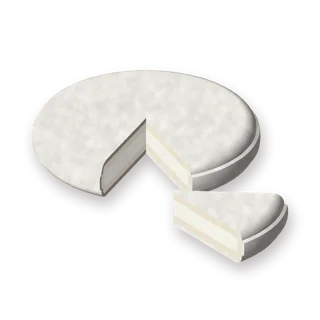
IGP, first protected 2025Sheep milk, bothSoft, bloomyBloomy rind
A small soft sheep's milk cheese of about 150 g, with a fine, slightly felted bloomy rind and a melting, creamy paste. It is made from whole Lacaune ewes' milk, raw or heat-treated, and began as a farm cheese for the end of lactation, when farmers stopped delivering milk to the Roquefort dairies and those dairies handed out their leftover rennet, according to INAO. It was recognised as a Protected Geographical Indication on 26 May 2025. Its area takes in a strip of northern Hérault (Le Caylar, Lunas and Avène among the listed communes), though most of it lies in Aveyron.
Taste: INAO describes milky aromas with notes of sheep's wool and fresh, sweet flavours, under a fine, slightly felted rind that hides a melting, creamy paste.
Ageing: Sold from the seventh day after renneting, after at least 12 hours draining at 16 °C or more and 3 days in a drying room at 10 °C or more (specification)
Made in: Semi-mountainous plateaux of the south-west Massif Central: most of Aveyron and parts of Lozère, Tarn, Hérault and Gard (INAO); the Hérault tourist board calls it a cheese of the Millau area