Käserei Horst
Family sour-milk dairy in Groß-Gerau, across the Rhine from Mainz, founded in 1862. Makes Mainzer Handkäse, Bauernhandkäse and Harzer; it does not ship, so the cheese is bought at the dairy.

Cheese · Rheinhessen
Also labelled Mainzer Handkäse
A cow's milk cheese from Groß-Gerau and the Gerauer Land in Hesse, across the Rhine from Mainz, where it was long sold and traded; called Handkäs in Mainz.
The sour-milk cheese Mainz calls its Handkäs, made from low-fat sour quark of cow's milk mixed with salt and ripening salts and formed into small loaves. German Wikipedia says a woman farmer named Kaul from Groß-Gerau created it in 1813 and sold it at the Mainz weekly market; Käserei Horst's company history also dates the area's cheese-making to 1813 and names Mainz as its main trading hub. Groß-Gerau had about 25 dairies around 1900. It is sold with or without caraway, served as Handkäs mit Musik, and thrown in small bags by the Haubinger guard at Mainz carnival.
Made in: Groß-Gerau and the Gerauer Land in Hesse, across the Rhine from Mainz, where it was long sold and traded; called Handkäs in Mainz
Hearty and savoury (herzhaft würzig, in Käserei Horst's words), with a supple, firm paste and an unmistakable aroma. It is very high in protein and low in fat, with a water content of 60 to 73%.
Rind: washed, orange and sticky
Wine and cheese
Handkäs mit Musik is lean, salty and sharp with vinegar and onion, and a dry Silvaner with medium acidity stays out of the marinade's way.
The Rhineland-Palatinate cheese route page of hofkaese.de, the artisan dairy association's site, says Mainz Handkäs' with Musik tastes delicious with a fine Spätlese from the Nahe, a suggestion rather than a custom. A Rheinhessen Kabinett or Spätlese's sweetness softens the vinegar and onion.
German Wikipedia says Mainzer Käse is served as Handkäs mit Musik, marinated in vinegar, wine, oil and onions; a dry estate or village Riesling's high acidity can match the marinade.
The grapes behind these winesRieslingSilvaner
From the source
Family sour-milk dairy in Groß-Gerau, across the Rhine from Mainz, founded in 1862. Makes Mainzer Handkäse, Bauernhandkäse and Harzer; it does not ship, so the cheese is bought at the dairy.
Cheese shop in Mainz's old town, run since 2014 by Christine Dörr, a trained fromelière. Alpine family-dairy cheeses, Rheinhessen wine, and tasting evenings in the Krämerei next door.
Yellow organic cheese wagon at the Mainz cathedral market on Fridays and Saturdays, with about 100 cheeses from the region and across Europe. NOVUM closed its Römerpassage cheese shop in June 2025.
Cheese stand at Alzey's Saturday market, run by Enrico Döhring and Nicole Bachmann since 2015, with up to 160 cheeses from France, Spain, Italy, Austria and Germany, plus salami.
Weekly market in the shadow of Mainz cathedral with 85 permanent stands; NOVUM's organic cheese wagon sells about 100 cheeses there on Fridays and Saturdays.
Saturday market on Alzey's Obermarkt with a cheese stand and a bakery, and local winemakers at the market breakfast from April to October.
Close, and the names overlap: in Mainz and the Rhine-Main area Mainzer Käse is simply called Handkäs. Both are small sour-milk cheeses of low-fat quark, but German Wikipedia notes that Handkäse can also be made as a white-mould cheese, which Mainzer Käse is not.
From Groß-Gerau in Hesse, across the Rhine from Mainz. German Wikipedia says it was created there in 1813 and sold at the Mainz market, and Käserei Horst's company history dates the area's cheese-making to the same year.
Often as Handkäs mit Musik, marinated in vinegar, wine, oil and onions, and offered with or without caraway.
Same cheeseboard
Plan the trip
Tastings and tours where it is made, and somewhere to stay.
Booking links go to our partners (GetYourGuide, Viator, Zen Hotels), who may pay us a commission. It never decides what we cover. Editorial standards.
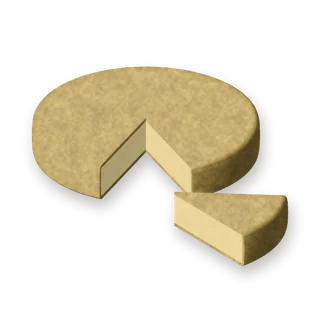
Sources: de.wikipedia.org, www.kaeserei-horst.de. The drawing is made from the cheese's recorded shape, rind and paste, not a photograph.