Key eras
Roman gold and the first Bierzo vines
1st century BC to 3rd century AD
Rome came to the Bierzo basin for gold, not wine, and worked the Médulas hydraulic mine on a scale that reshaped the landscape south of Ponferrada. The garrison and administrative town of Bergidum Flavium and the mining settlements around it created the first steady local demand for wine, and the Ruta del Vino del Bierzo dates the comarca's link to viticulture to that Roman period. Las Médulas has been a UNESCO World Heritage site since 1997.
Carracedo and the Cistercian vine
990 to 15th century
The monastery of Santa María de Carracedo was founded in 990 by Bermudo II and rebuilt in the 12th century, when it passed to the Cistercians. Bierzo Enoturismo credits the Cistercian order with spreading vine growing and winemaking through much of the comarca. The monastery held economic and religious jurisdiction over houses as far away as Galicia and Asturias, and the vineyards worked around Carracedelo today sit within metres of its walls.
The Templars at Ponferrada
12th to 14th century
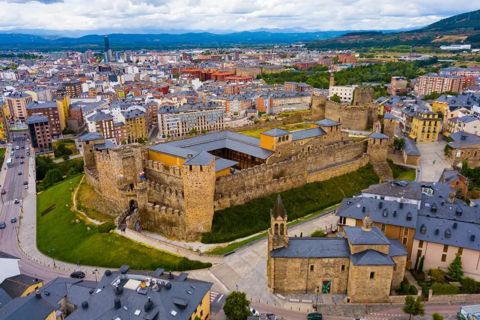
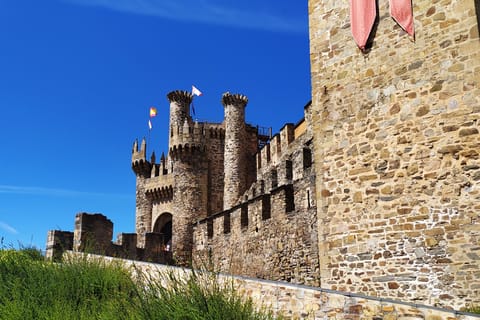
The Order of the Temple took charge of the crossing at Ponferrada and built the castle that still dominates the town, and held the castles of Sarracín and Auctares in the Valcarce valley between the 12th and 14th centuries to protect pilgrims. Their presence fixed the Camino Francés on the line it still follows through Ponferrada, Cacabelos and Villafranca, which is the line the vineyard villages grew along.
The Camino and the Puerta del Perdón
12th to 16th century
Villafranca del Bierzo grew as a Frankish settlement on the pilgrim road and became known as the small Compostela. Pilgrims too ill to cross into Galicia could obtain the jubilee indulgence at the Puerta del Perdón of the church of Santiago, which made the town a terminus in its own right. The Calle del Agua, still lined with cellars, is the street that carried that traffic.
Gabriel de Robles and the Cristo de la Esperanza
17th century
Gabriel de Robles, an indiano born in Villafranca, paid for the works that became the convent of San Nicolás and donated an ebony Christ, the Cristo de la Esperanza, for its main altarpiece. The image displaced San Sebastián as the town's patron, and the September feast built around it is still the week when Villafranca's Calle del Agua runs its ronda de vinos.
The 1761 cellar record at Canedo
1761
The books of the Palacio de Canedo record 170 miedros of good wine held in the palace cellar in 1761, one of the few dated production figures that survives for a single Bierzo estate before the modern era. The same cellar is still in use, now under Prada a Tope, and the estate reads that entry as the start of its own continuous line.
Vinos Guerra and the export trade
1879 onwards
Vinos Guerra was trading from Cacabelos from 1879 and became the house that moved Bierzo wine out of the comarca and into Europe and the Americas. Its Cacabelos premises on the Avenida de la Constitución still hold the co-operative that grew out of it, and the same building houses the town's Museo del Vino.
The 1892 bodega houses of Cacabelos
1892 to 1936
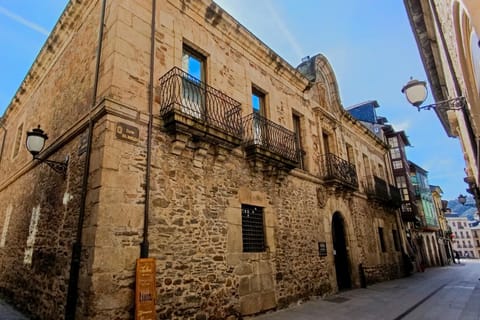
The building that now holds the M.AR.CA museum went up in 1892 as a private house on the Camino and was converted in 1936 into a bodega for the Rofemar company. Its twelve storage tinos, the basement lagar and the glazed timber gallery were all kept in the 2004 restoration, which makes it the clearest surviving record of how a Cacabelos town bodega was laid out.
Phylloxera and the twentieth-century recovery
1890s to 1950s
Phylloxera reached the north-west at the end of the 19th century and emptied much of the Bierzo vineyard. What went back in afterwards was mostly goblet-trained Mencía on grafted rootstock, planted parcel by parcel by smallholders, which is why the modern comarca is a patchwork of very small plots rather than large blocks. Those replanted parcels are the old vines producers work today.
The co-operative era begins at Camponaraya
1963
Viñas del Bierzo was set up at Camponaraya in 1963 and, per the Ruta del Vino del Bierzo, was the first co-operative bodega established in the comarca. Pooling fruit from hundreds of smallholders gave Bierzo grapes a route to market for the first time since phylloxera, and the co-operative model still accounts for a large share of the DO's volume.
Botillo becomes a national festival
1972 onwards
Bembibre started the Festival Nacional de Exaltación del Botillo in 1972 and it later earned the Fiesta de Interés Turístico Nacional label. Fixing a national date around the comarca's own cured pork dish gave Bierzo a gastronomic identity outside León years before the wines had one, and the February gala still fills Bembibre every year.
Organic viticulture arrives at Villafranca
1982 onwards
Pérez Caramés has been making organic wine at Villafranca del Bierzo since 1982, and now farms 32 hectares at El Toleiro entirely under organic rules. Working that way from the early 1980s, well before the DO existed, gave the comarca a reference point when other estates converted in the 2000s and 2010s.
DO Bierzo is recognised
1988 to 1989
The denomination was provisionally recognised on 3 June 1988 and a provisional Consejo Regulador appointed on 3 October of the same year. DO Bierzo and its Reglamento were formally approved on 11 November 1989 and published in the BOE on 12 December 1989. The Consejo Regulador works from C/ Mencía 1 at Campo de San Bartolo in Cacabelos.
Arganza and the return of the single estate
1998 to 2002
Pittacum was founded at Arganza in 1998 in the 19th-century Casona, and joined the Terras Gauda group in 2002. It was among the projects that moved Bierzo away from bulk co-operative volume towards estate-labelled Mencía from the late 1990s, and it has kept its doors open to visitors year round since.
Corullón, 1999
1999 onwards
Álvaro Palacios and his nephew Ricardo Pérez Palacios began making wine at Corullón in 1999, in tribute to Álvaro's father José. They assembled the estate parcel by parcel on the steep slate slopes above the village and farm around 30 hectares of very old vines under biodynamic discipline, restoring an old stone cellar at Villafranca del Bierzo to work in.
Dominio de Tares and the Bierzo Alto
2000 onwards
Dominio de Tares was built at San Román de Bembibre in 2000 and pulled attention east, to the higher and cooler Bierzo Alto that the valley-floor co-operatives had largely ignored. It has fermented with indigenous yeasts since the 2007 vintage and takes visitors by appointment.
An 18th-century caserón at Cacabelos
2003 onwards
Cuatro Pasos took over an abandoned 18th-century manor house on Cacabelos' Calle Santa María in 2003, turning the stables into cellars and the old concrete vats into an ageing hall. The name comes from four bear prints found in a high Bierzo vineyard. Its cellar is currently closed to the public.
Villa and Paraje
2017 onwards
Under the revised Pliego de Condiciones, DO Bierzo labels may carry the name of a smaller geographical unit. Vino de Villa requires all the fruit from one municipality or pedanía, Vino de Paraje all of it from one recognised named site, each with a tighter yield limit. The Consejo Regulador has published a cartographic base identifying every paraje by cadastral reference, municipality by municipality.
Ten municipalities come back in
2019
The 2019 revision of the Pliego de Condiciones brought ten municipalities back inside DO Bierzo on the grounds that they had been vineyard land in the past: Benuza, Berlanga del Bierzo, Fabero, Folgoso de la Ribera, Igüeña, Oencia, Sobrado, Toreno, Torre del Bierzo and Trabadelo. The move widened the denomination well beyond the valley floor around Cacabelos.
ENAC accreditation, February 2021
2021
In February 2021 the Consejo Regulador obtained ENAC accreditation, which the DO records as making it the first wine denomination in Castilla y León able to certify production to the UNE-EN ISO 17065 product-certification standard. It moved the DO's controls from self-declaration to independently audited certification.