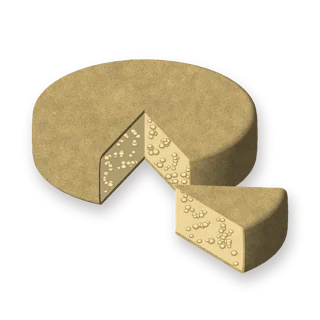
DOP, first protected 2015Cow milk, rawHardNatural rind
A hard cow's-milk cheese made from raw milk in the Valle Camonica and Sebino Bresciano mountain communities of Brescia province, and listed by the Franciacorta consortium among its typical cheeses. At least 80 percent of the herd must be Grigio Alpina, Pezzata Rossa or Bruna, with Bruna at least 60 percent of the cows in milk. The milk is partly skimmed by standing, cooked, pressed and aged on wooden boards for at least 100 days in rooms called silter. Wheels are 34 to 40 cm across, 8 to 10 cm high and weigh 10 to 16 kg. Qualigeo says the name is almost certainly Celtic and that the first written trace is from the late 17th century, in a chancellor of Zone's document naming Monte Guglielmo.
Taste: Mostly sweet, faintly bitter, and slightly peppery in very aged wheels, per Qualigeo. The aroma is lasting, with dried fruit, a hint of forage and chestnut flour. The paste is hard, crumbly and not very elastic.
Ageing: At least 100 days on wooden boards in controlled-temperature rooms
Made in: Municipalities of the Valle Camonica and Sebino Bresciano mountain communities, Brescia province

Cow milk, rawHardNatural rind
A hard cheese from raw, partly skimmed milk of Brown Alpine cows, made only in the commune of Bagolino, in the Val di Caffaro in Brescia province, and listed by the Franciacorta consortium among its typical products. The cheesemakers add a teaspoon of saffron to the broken curd, cook over a wood fire in copper vats and oil the rind with linseed oil during a long ageing. It is a Slow Food presidium and not a DOP; a mark pressed on the side of the wheels since 2004 identifies those of the producers' cooperative. Italian Wikipedia gives a wheel about 40 cm across, 12 to 15 cm high and around 18 kg. Slow Food says locals call it the grana of the poor, but it is above all a table cheese.
Taste: From 10 to 12 months the paste turns granular and breaks into flakes. The nose is spicy with saffron over green notes of pasture and hay, then a touch of almond and a slightly peppery finish that grows with age, per Slow Food.
Ageing: At least 12 months by the presidium rules; Slow Food says the average is 24 or 36 months
Made in: Commune of Bagolino, Val di Caffaro, Brescia province

Goat milk, rawSmokedNatural rindAlso Fatulì
A small smoked goat cheese from the Val Saviore, a side valley of the Valle Camonica in the Adamello park, which the Franciacorta consortium lists among the typical cheeses of its area. It is made from the raw milk of the Bionda dell'Adamello goat, cooked, drained in moulds 10 to 14 cm across, salted, smoked over juniper branches and berries and aged one to six months. The forms are about 4 to 6 cm high and weigh 300 to 500 g. The name means little piece in dialect. Slow Food, which runs a presidium for it, says more than half of the roughly 4,000 Bionda dell'Adamello goats registered in Italy are in the Valle Camonica, and that production runs from spring to late autumn.
Taste: Elastic paste from pale straw to deep yellow, compact or with small eyes. The aroma is clean and strong, with evident smoke plus herbal and dried-fruit notes and a long finish, per Slow Food.
Ageing: One to six months after smoking
Made in: Val Saviore, Valle Camonica, Brescia province

DOP, first protected 1993Cow milk, bothSemi, softNatural rind
A soft square table cheese from cows' milk, raw or pasteurised, made across ten Lombard provinces that include Brescia, and named by the Franciacorta consortium among the cheeses of its area. Qualigeo sets two types: fresh, matured 2 to 30 days, and aged, over 30 days. The square forms have flat faces and straight sides and weigh 1.5 to 3.5 kg, with a thin soft white-pink rind that turns grey-green and reddish with age. The name comes from the quartirola, the grass grown after the third summer hay cut, and Qualigeo dates the cheese, once called stracchino quadro, to the 10th century.
Taste: Slightly acidic and aromatic when fresh, more aromatic when aged, per Qualigeo. The paste is compact and even, slightly lumpy and crumbly, and melts more easily as it ages.
Ageing: Fresh type 2 to 30 days; aged type over 30 days
Made in: Bergamo, Brescia, Como, Cremona, Lecco, Lodi, Milano, Monza-Brianza, Pavia and Varese provinces