
Lambrusco di Sorbara ★ 4.6
A red Lambrusco variety named for the village of Sorbara in Modena province, with its own DOP since 1970. Grown on the flat lowlands, it gives grapes rich in minerals and clean, clear fragrances in dry, frothy wines.
The grapes that define Emilia-Romagna: the canonical varietals and how the region expresses them.
The grapes that define Emilia-Romagna: the canonical varietals and how the region expresses them.
A red Lambrusco variety named for the village of Sorbara in Modena province, with its own DOP since 1970. Grown on the flat lowlands, it gives grapes rich in minerals and clean, clear fragrances in dry, frothy wines.

The Lambrusco of the hills south of the Via Emilia, with its own DOP of Castelvetro. Vineyards on slopes give a darker, more intense wine with a purplish foam; the variety has a thick, firm skin.

Lambrusco grown around Santa Croce di Carpi, which has its own DOP, and across Reggio Emilia, where Reggiano DOP covers a Lambrusco Salamino. It ripens late and gives steady yields.

Romagna's king grape. Romagna Sangiovese DOC needs at least 85 percent Sangiovese; a 1672 Faenza notarial deed is the oldest known document naming it. Superiore and Riserva run from Modigliana to Rimini.

Romagna's classic white, grown only in Romagna and the first Italian white to reach DOCG, in 1987. Romagna Albana DOCG needs at least 95 percent Albana and runs from dry to sweet passito; Bertinoro is called its cradle.

The native white of the Bologna hills, also called Grechetto Gentile. Colli Bolognesi Pignoletto DOCG, recognised in 2010, needs 95 percent Pignoletto and 12 percent alcohol, and comes still, frizzante and spumante.

An aromatic white that was for years the main white of Piacenza and is widely grown in Parma province; in Reggio it makes distinct whites beside Spergola. Piacenza estates bottle it still and as a sweet spumante.

Partner of Croatina in Piacenza's Gutturnio, which holds 55 to 70 percent Barbera, and still the historic wine of the Bologna hills. In Parma's hills it was praised as far back as the 1800s around Langhirano.

Known locally as Bonarda, Croatina makes up 30 to 45 percent of Gutturnio beside Barbera. Piacenza's traditional semi-sparkling red is also made still, and in a riserva that can age well.

A native Piacenza white with compact bunches, once nearly eradicated in favour of Malvasia di Candia and replanted since the late 1970s. Ortrugo now makes up about 12 percent of output and has had its own PDO since 2010.

Romagna's Trebbiano, covered by its own Romagna DOC and one of the main grapes of Colli di Faenza and Rimini DOC. Bertinoro and Modigliana estates bottle it, some as a skin-macerated white.

Discover regional wine gems like Pignoletto & Sangiovese with a fun game and buffet in the vibrant heart of Bologna.
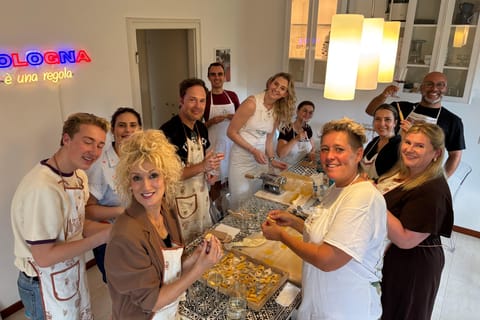
Intimate class (max 12) in a deluxe Bologna home. Learn scratch-made pasta & tiramisu. Enjoy your meal with unlimited Sangiovese, Chardonnay & Pinot Grigio. 100% hands...

Wine and charcuterie tasting in the liveliest and most popular district of Bologna, the Pratello, a meeting place for students, artists, and locals, where you can imme...
Wine tastings and winery visits in Emilia-Romagna (11) · Wine tours and day trips in Emilia-Romagna (8) · Wine and cheese tastings in Emilia-Romagna (4) · Cheese tastings and dairy visits in Emilia-Romagna (22)
Peak wine-travel season in Emilia-Romagna is spring through autumn, with harvest the standout window.
classified-growth and grand-cru estates require booking days to weeks ahead; smaller family domaines often take walk-ins midweek.
most estates open 10:00 to 17:00 by appointment, often closed Sunday and Monday.
tipping is not expected at tastings; buying a bottle from the cellar door is the customary thank-you.
Ask the next local you meet what they would order. Emilia-Romagna rewards trust.