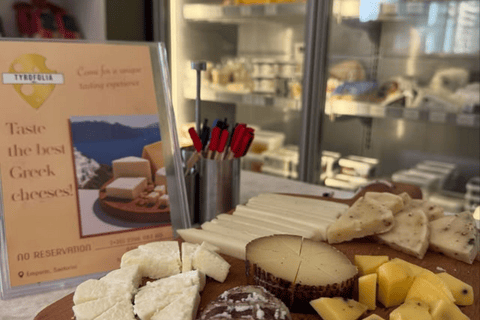
Sheep and goat milkFreshAlso Χλωρό Σαντορίνης
Chloro, from the Greek word for fresh, is a soft sheep or goat cheese of Santorini. The Greek cheese reference Cheese Lovers says it is made on the island from sheep or goat milk in winter and spring, when there is plenty of grass, and is usually eaten fresh. It can instead be kept in brine until it hardens, and is then grated in cooking. The travel guide Greece Insiders calls chlorotyri a soft, tangy goat cheese made in small quantities and lists a Greek salad topped with it instead of feta among Santorini's traditional dishes.
Taste: Cheese Lovers says fresh chloro is soft and creamy with a slightly salty, slightly sour taste and is very often scented with coriander. Once it has hardened in brine it is used grated in cooking. Greece Insiders calls the cheese soft and tangy.
Ageing: Eaten fresh, or kept in brine until it hardens
Made in: Santorini

PDO, first protected 1994Cow and sheep and goat milkOtherAlso Κοπανιστή
Kopanisti is a soft, salty, creamy cheese of the Cyclades with a tangy flavour, made from Cycladic cow, sheep or goat milk or a mix. Per the PDO texts, the curd stands 20 to 24 hours, is drained in sacks and salted at 4 to 5 percent, then sits in wide-necked containers in a cool, humid place until mould grows on the surface; it is kneaded two to four times over a ripening of usually 30 to 40 days. Fresh butter up to 15 percent has been allowed since 2013. Greece recognised the PDO in January 1994 and the EU registered it in 1996. On Santorini, Aroma Avlis at Artemis Karamolegos Winery in Exo Gonia serves it as a spread in its Greek mezze platter.
Taste: Soft and creamy, salty and tangy. The PDO summary says it is known for a woody and peppery taste and esteemed for its piquancy and rich aroma; the current single document adds a yellowish to tan colour. English Wikipedia says it is most popularly eaten as mostra: dry bread with kopanisti, chopped tomatoes and olive oil.
Ageing: Usually 30 to 40 days, per the PDO single document
Made in: The Cyclades

PDO, first protected 2020Sheep and goat milk, rawHardNatural rindAlso Αρσενικό Νάξου
Arseniko is the hard, spicy table cheese of Naxos, made from non-pasteurised sheep and goat milk and sold in whole cylindrical wheels weighing 1 to 4 kg. The EU single document describes a whitish to yellowish cheese with a hard but relatively thin rind, and requires at least three months of maturing because the milk is raw. It was registered as a PDO in 2020. Naxos is a different island from Santorini, but arseniko is on the menu at Aroma Avlis, the restaurant at Artemis Karamolegos Winery in Exo Gonia, with Naxos bresaola and on its cheese plateau.
Taste: The EU single document gives an intense, spicy, pleasant and bittersweet taste, a buttery and soft texture and a rich aroma, becoming spicier and more aromatic as it matures.
Ageing: At least 3 months; made from December to May
Made in: Naxos: eleven mountain and hill communities and the Small Cyclades

PDO, first protected 1994Cow milk, pasteurisedHardNatural rindAlso Σαν Μιχάλη
San Michali is the hard cow's milk cheese of Syros, made from the pasteurised milk of cows raised on the island, pressed hard, brined and ripened for about three and a half months. The product specification describes a cylindrical cheese with a dry, hard rind of yellow-white to yellow and a hard paste from white to yellow-white. Greek Wikipedia dates the PDO to 1994 and eAmbrosia shows it registered in 1996. Syros is another Cycladic island, not Santorini, but San Michali is on the cheese plateau at Aroma Avlis in Exo Gonia.
Taste: A table cheese with a piquant taste and a characteristic aroma, per the product specification. Greek Wikipedia calls it salty and sharp, eaten on its own with bread or fruit or used in cooking.
Ageing: About three and a half months, per the product specification
Made in: Syros

PDO, first protected 1988Sheep and goat milk, bothOtherAlso Φέτα
Feta is the white brined cheese of mainland Greece and Lesbos, made from sheep's milk or sheep's milk with up to 30 percent goat's milk, dry salted in the mould and then ripened in brine for at least two months. Greece protected its production area in 1988 and recognised the PDO in 1994. The EU registered it in 1996, that was annulled after a court challenge, and the registration in force dates from 2002. It covers mainland Greece and Lesbos and excludes all other islands, so none is made on Santorini, but Aroma Avlis serves it in a Greek salad and as a cream with tomato fritters.
Taste: English Wikipedia describes a soft cheese with small or no holes and no skin, crumbly with a slightly grainy texture, formed into large blocks and aged in brine. The PDO summary calls it a white table cheese stored in brine.
Ageing: Ripened at least 2 months, in brine
Made in: Mainland Greece and the department of Lesbos