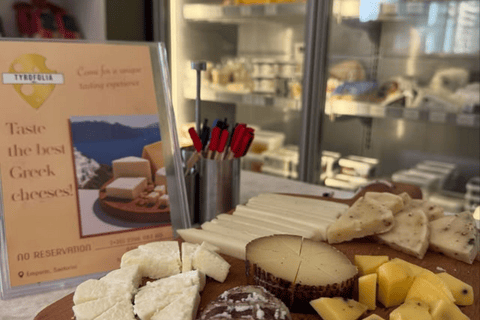
What is chloro cheese?
Cheese Lovers describes it as a Santorini cheese made from sheep or goat milk in winter and spring, soft and creamy when fresh, slightly salty and sour, and often flavoured with coriander.
Does chloro have a protected name?
No. Chloro has no entry in the EU's eAmbrosia register of protected food names; it is a traditional local cheese of the island.
How do you eat it on Santorini?
Fresh, or grated once hardened in brine. Greece Insiders lists a Greek salad topped with chlorotyri instead of feta among Santorini's traditional dishes.
Is kopanisti made on Santorini?
The PDO area is the Regional Unit of the Cyclades, which includes Santorini. English Wikipedia names Mykonos, Tinos, Andros, Syros and Naxos as production islands and says it has been made on Mykonos for more than 300 years. On Santorini it appears on the Aroma Avlis menu as a kopanisti cheese spread.
When did kopanisti become a PDO?
Greece recognised the designation by ministerial decision 313046 of 14 January 1994, and the EU registered it in 1996.
How long does it ripen?
The PDO single document gives a ripening period that usually lasts 30 to 40 days, with the surface mould kneaded through two to four times. English Wikipedia gives 45 to 60 days.
Where is Arseniko Naxou made?
In the communities of Apeiranthos, Damarionas, Danakos, Keramoti, Koronida, Koronos, Kinidaros, Mesi, Moni, Filoti and Chalkeio on Naxos, and the Small Cyclades.
How long is it matured?
At least three months before release, because it is made from non-pasteurised milk. It is made between December and May.