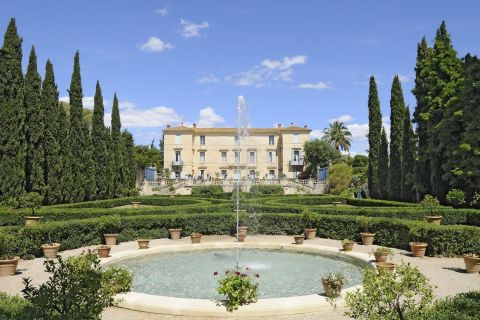
The Cevennes, the mountain range north of Montpellier, is a UNESCO Biosphere Reserve and the home of the Pelardon goat cheese AOP. The cheese pairs naturally with the rustic Cevennes IGP reds and whites from small mountain producers. The day-trip combines a chestnut-orchard walk in autumn, a Pelardon cheese tasting at a goat farm, and a wine cellar visit at one of the small Cevennes-edge growers. The market town of Anduze is the gateway and has the Bambouseraie tropical garden as a non-wine highlight.
Pours: Cevennes IGP rustic reds (Carignan-Grenache), Pelardon goat cheese pairings, Chestnut-honey aperitifs
Tip: Pelardon farms cluster around Ales and Saint-Hippolyte-du-Fort. The Cevennes mountain vines are often hidden in chestnut forest at 400-600 metres altitude. The Train a Vapeur des Cevennes steam railway from Anduze runs in summer.
Carcassonne's UNESCO World Heritage medieval cite is the most-visited monument in southern France outside Paris. The wines of the surrounding Cabardes AOC (north of the city) and Malepere AOC (south of the city) sit at the unique geographic intersection where Atlantic-influenced Bordeaux grapes (Cabernet Sauvignon, Merlot) and Mediterranean Languedoc grapes (Syrah, Grenache) are blended in the same wines. The combination of medieval-city tour and cellar visits is a textbook half-day plus.
Pours: Cabardes AOC red (the Atlantic-Mediterranean blend zone), Carcassonne old-town cassoulet pairings, Malepere AOC red (Bordeaux-grape neighbour)
Tip: The Carcassonne cite is busiest in mid-summer; visit in spring or autumn for a calmer walk. The Cabardes cellars at Chateau de Pennautier and Chateau Ventenac are 15 minutes north of the city.
The Roussillon is the Languedoc's natural sweet-wine neighbour, an hour south along the A9. Banyuls and Collioure share the same terraced Grenache vineyards on the schist cliffs above the Mediterranean: Banyuls is the fortified sweet style, Collioure the dry red counterpart. Maury, an hour inland, makes a similar Grenache-based Vin Doux Naturel from inland schist. The Roussillon is sometimes folded into Languedoc-Roussillon as a single region but its appellations and identity are distinct.
Pours: Banyuls Vin Doux Naturel (Grenache, fortified), Collioure rouge Grenache-Syrah from the same vineyards, Maury VDN sweet red
Tip: The cellars at Banyuls (Domaine de la Rectorie, Cellier des Templiers) and Collioure cluster along the coast road. Combine with the Cap Bear hike for vineyard-and-sea views. Maury is inland (1 hour from Banyuls) and works well as a second-day extension.
Provence's coastal wine zones sit east of Languedoc along the Mediterranean. Bandol is the Mourvedre heartland of France, its terraced amphitheatre vineyards above the bay of La Ciotat producing structured, long-ageing reds from Domaine Tempier, Chateau de Pibarnon and Domaine de Terrebrune. Cassis, the small white-wine AOC east of Marseille, makes Clairette-and-Marsanne whites unique in Provence. The combined day-trip is a serious commitment from Languedoc but feasible from Montpellier with an early start.
Pours: Bandol rouge Mourvedre-led, Cassis blanc Clairette-Marsanne, Bandol rose from old-vine Mourvedre
Tip: Bandol cellars are clustered around La Cadiere d'Azur and Le Castellet; Domaine Tempier is the canonical visit and requires advance booking. Cassis is harder to reach by road; the boat from Cassis port to the Calanques is the natural pairing with the white wine.
The Spanish Catalan border is two hours south of Narbonne via the A9 and the Le Perthus pass. DO Emporda, the Catalan wine zone closest to France, makes Garnacha-Carinena reds and dry whites in the schist-and-clay terroir north of Girona. Combine with the Figueres Dali Museum or the Costa Brava cliffs at Cadaques for the canonical day-trip. The drive south on the A9 is one of Europe's most scenic motorway routes.
Pours: Emporda Garnacha-Carinena blends, Costa Brava cava from family operators, Catalan dry rose
Tip: DO Emporda cellars cluster around Sant Marti d'Empuries and Vilajuiga; Castillo Perelada and Espelt Viticultors are the two most accessible large producers. The Greek-Roman ruins at Empuries are 30 minutes from the cellars.
Chateauneuf-du-Pape, the southern Rhone's flagship AOC, sits 1 hour 15 minutes north-east of Nimes via the A9 and the A7. The galets roules pebble-soil vineyards of the village cluster around the medieval papal-summer-palace ruins, with Domaine du Pegau, Chateau de Beaucastel and Chateau Rayas as the canonical visits. Gigondas, 30 minutes further into the Dentelles de Montmirail, offers a more rugged Grenache style. The Tavel rose AOC, 10 minutes from Chateauneuf, makes the original French serious rose.
Pours: Chateauneuf-du-Pape rouge 13-grape blend, Gigondas Grenache-led reds, Tavel rose (the original French rose AOC)
Tip: Chateauneuf cellars take walk-ins but appointment booking is essential at Pegau, Beaucastel and Rayas. The Dentelles de Montmirail at Gigondas are a scenic drive; pair with the village of Sablet for an aperitif. The day-trip extends naturally into a Provence weekend.