DOP, first protected 1985Sheep milk, rawSemi, softNatural rind
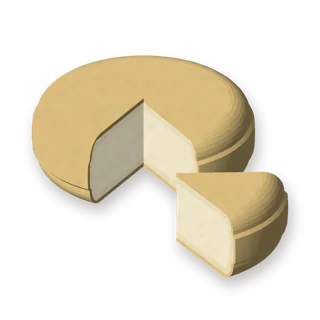
Raw ewe's milk from Bordaleira Serra da Estrela or Churra Mondegueira sheep, curdled with thistle flower (Cynara cardunculus) rather than animal rennet and ripened in two phases over about 45 days. The whole cheese is a flat wheel, 8 to 20 cm across and 4 to 6 cm high in the specification, and Portuguese Wikipedia gives its weight as 0.7 to 1.5 kg; it is drawn here at the midpoint of the size ranges. The paste is semi-soft, buttery and white to yellowish. It was first protected when Decreto Regulamentar 42/85 of 5 July 1985 created the demarcated region of Queijo Serra da Estrela, and the EU registered it as a DOP in 1996 (Regulation 1107/96). The DOP area includes Nelas, Mangualde, Penalva do Castelo and Viseu, beside the Dão vineyards.
Taste: Mild, clean and slightly acidulous aroma and flavour, with a buttery paste. Under a thin, smooth straw-yellow rind, the specification describes the paste as closed, moderately buttery, creamy and unctuous, deforming when cut; it scores an overly fluid consistency as a defect.
Ageing: At least 30 days; the specification describes two ripening phases running to about day 45
Made in: 18 municipalities of the Serra da Estrela area across the districts of Viseu, Coimbra, Guarda and Castelo Branco, including Nelas, Mangualde, Penalva do Castelo, Carregal do Sal and Viseu in the Dão country

DOP, first protected 1985Sheep milk, rawHardNatural rind
The long-aged form of Queijo Serra da Estrela DOP, made the same way from raw ewe's milk and thistle flower but ripened for at least 120 days. The 2022 specification gives a low cylinder of 0.3 to 1.2 kg, 6 to 20 cm across and 2 to 6 cm high, with a paste that runs from semi-hard to extra-hard and turns orange-brown. It is sold under the same DOP as the standard cheese, first protected by Decreto Regulamentar 42/85 of 5 July 1985 and registered by the EU in 1996.
Taste: Pleasant, persistent and clean in aroma and flavour, from strong to slightly strong, lightly peppery and salty, according to the DOP summary and the Estrelacoop cooperative.
Ageing: At least 120 days
Made in: Same area as Queijo Serra da Estrela DOP: 18 municipalities of the Serra da Estrela area, including Nelas, Mangualde, Penalva do Castelo and Viseu

DOP, first protected 2001Sheep milkWhey
A whey cheese made from the whey left by Queijo Serra da Estrela. Water (10 to 20 percent) is added to the whey, which is heated slowly with constant stirring; at 82 C up to 18 percent sheep's milk may be added, and at 96 C the proteins set into curds. The curds are drained into an irregular low cylinder of 150 to 400 g. Traditionally the curds drained in small baskets of fine chestnut wicker (açafates) and were wrapped in cabbage or mulberry leaves; today they go into containers and are wrapped in vegetable paper. Eaten fresh. Despacho 19662/2001 of 18 September 2001 recognised it as a Portuguese denominação de origem while the EU application was pending, and the EU registered it as a DOP in 2005.
Taste: A soft, uniform, creamy to slightly granular white mass with a pleasant flavour and aroma that melt in the mouth, according to the DOP summary. Estrelacoop lists it eaten plain, dissolved in milk or coffee, or with honey or pumpkin preserve and nuts.
Ageing: Eaten fresh, not aged
Made in: Same area as Queijo Serra da Estrela DOP: 18 municipalities of the Serra da Estrela area, including Nelas, Mangualde, Penalva do Castelo and Viseu
