Key eras
Catullus and the calices amariores
circa 49 BC
Catullus writes of calices amariores, bitterer cups, in Carme 27. Italian scholarship reads the line as a possible early trace of the dried-grape wine that became Amarone.
The Italian Wikipedia entry on Amarone della Valpolicella cites Catullus, Carme 27, circa 49 BC, for the phrase calices amariores.
The Roman pagus in the valleys
1st century BC
Rome organised the valleys north of Verona into a pagus, a rural district. The name survives in local usage and gives the Verona travel agency Pagus Wine Tours its name.
Pagus Wine Tours record that the name refers to the territorial district created by the Romans in Valpolicella around the first century BC.
Cassiodorus orders Acinaticum for Theodoric
circa 500 AD
Cassiodorus ordered Acinaticum for the table of Theodoric, describing a wine of dried grapes from Valpolicella as winter must, cold blood of the grapes.
Both the Amarone and Recioto entries on Italian Wikipedia quote Cassiodorus on Acinaticum, a sweet wine of dried Valpolicella grapes served to Theodoric.
The Edict of Rothari protects the vines
643 AD
The Lombard Edict of Rothari set penalties for damaging vines or stealing bunches, evidence that viticulture in the Verona hills was worth legislating over.
The Amarone entry on Italian Wikipedia cites the Editto di Rotari for penalties against damaging vines or stealing grapes.
Recioto takes its name from the ear of the bunch
medieval usage
Recioto comes from the Veneto word recia, ear. Only the upper, best-exposed shoulders of the bunch, the ears, go to the drying loft, because they carry the most sugar.
The Recioto della Valpolicella entry on Italian Wikipedia derives the name from recia, ear, for the top section of the bunch used in appassimento.
The 1503 estimo records a rich wine valley
1503
A 1503 land valuation records Valpolicella as a wealthy valley already famous for its wines, the first documentary evidence of the wine trade as an economic engine here.
The Amarone entry on Italian Wikipedia cites an estimo of 1503 attesting that the production zone was a rich valley famous for its wines.
Villa Della Torre is built at Fumane
16th century
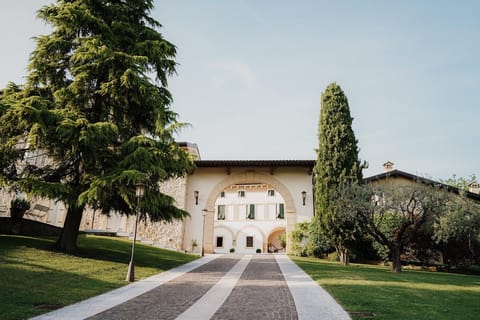
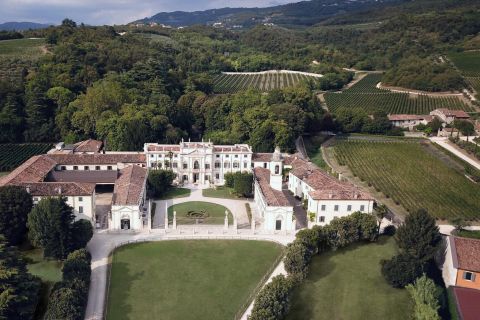
The Della Torre family commissioned a villa at Fumane laid out on the plan of a Roman domus, with work attributed to Giulio Romano and Michele Sanmicheli.
The Italian Wikipedia entry on Villa Della Torre dates the villa to the sixteenth century and describes the peristyle plan modelled on the Roman domus.
The marogne terraces shape the hillsides
16th to 19th century
Generations of growers cut the limestone hillsides into terraces held by marogne, dry-stone walls built without mortar from the stone cleared out of the vineyard.
Monte Dall'Ora document their terraced marogne at Castelrotto, the dry-stone walls that hold the Valpolicella Classico slopes.
Scipione Maffei proposes the word amaro
18th century
The Veronese scholar Scipione Maffei suggested calling amaro a Valpolicella wine of particular grace, the first move toward the word that became Amarone.
The Amarone entry on Italian Wikipedia records that the reputation of the local wine consolidated in the 1700s when Scipione Maffei proposed the term amaro.
Pindemonte's literary salon at Novare
18th century
The villa at Novare, in production since the 1500s, gained a walled brolo and a romantic park in the 1700s, and Ippolito Pindemonte held a literary salon in its frescoed rooms.
Villa Mosconi Bertani record Pindemonte's salon at the villa; the Italian Wikipedia entry on Pindemonte records his part in laying out the gardens.
Family cellars take shape at Marano
from 1870
San Rustico dates its winegrowing tradition at Marano to 1870, and records a gold medal awarded to great-grandfather Luigi by the consulate in Copenhagen in 1908.
San Rustico's own history page dates the family tradition to 1870 at Marano di Valpolicella and cites the 1908 Copenhagen consulate medal.
The first laboratory notes on Amarone
late 19th century
The bulletin of Verona's experimental agricultural station carried the first organoleptic analyses of the dry version of the dried-grape wine.
The Amarone entry on Italian Wikipedia dates the first organoleptic analyses to the bulletin of the stazione agraria sperimentale di Verona at the end of the nineteenth century.
The Valpolicella consortium is founded
1925
Growers, winemakers and bottlers formed the Consorzio per la Tutela dei Vini Valpolicella in 1925. It now covers 19 comuni in the province of Verona.
The Consorzio Tutela Vini Valpolicella records its founding in 1925 and a production zone of 19 comuni in the province of Verona.
Cellars begin making a dry Recioto
1920s
Local cellars started bottling a Recioto di tipo secco, a Recioto amaro, fermented out to distinguish it from the sweet original.
The Amarone entry on Italian Wikipedia records that in the 1920s local cellars began producing a Recioto di tipo secco or Recioto amaro.
The Negrar cooperative opens
1933
Cantina Valpolicella Negrar was founded in 1933. Its members now farm 700 hectares in the Classico zone, and the cooperative counts 240 of them.
Cantina Valpolicella Negrar dates itself to 1933 and publishes the figures of 240 members farming 700 hectares in Valpolicella Classica.
This is not an amaro, it is an amarone
1936
The name is traced to 1936 at the Cantina Sociale Valpolicella, where the cellar master Adelino Lucchese drew a forgotten cask and declared that this was not an amaro but an amarone.
The Amarone entry on Italian Wikipedia attributes the name to Adelino Lucchese at the Cantina sociale Valpolicella in 1936.
Amarone reaches the market
1953
The commercial release of a wine labelled Amarone della Valpolicella dates to 1953, seventeen years after the cellar-floor christening at the Negrar cooperative.
The Amarone entry on Italian Wikipedia dates the commercialisation of Amarone della Valpolicella to 1953.
Valpolicella becomes a DOC
1968
The denominazione di origine controllata for Valpolicella was approved in 1968, fixing the grape mix and the boundaries of the Classico zone for the first time.
The Amarone entry on Italian Wikipedia records the approval of the denominazione di origine controllata in 1968.
The ripasso method and its DOC
from the 1960s to 2010
Ripasso pours the base Valpolicella over the pressed skins of Amarone or Recioto for about 15 to 20 days before ageing, taking on colour, weight and aroma from the dried fruit.
The Valpolicella Ripasso entry on Italian Wikipedia describes the technique of resting the base wine on freshly pressed Amarone marc for roughly 15 to 20 days.
The 2010 split into DOCG and DOC
2010
The decree of 24 March 2010 separated four wines: Amarone della Valpolicella and Recioto della Valpolicella became DOCG, Valpolicella and Valpolicella Ripasso DOC.
The Amarone entry on Italian Wikipedia cites DM 24.03.2010, published in Gazzetta Ufficiale n. 84 of 12.04.2010, for the split of the four typologies.
The drying rule: 100 to 120 days in the fruttaio
current production rules
The rules require the bunches to be laid in a single layer and rested in a fruttaio for 100 to 120 days until they lose half their weight. Conditioning is allowed, heating is not.
The Amarone production rules summarised on Italian Wikipedia specify a single layer, a fruttaio period of 100 to 120 days and a weight loss of half, with conditioning but no heating.
Villa Della Torre becomes a winery again
2008 to 2019
Marilisa Allegrini bought Villa Della Torre in 2008 and turned it into an art and wine relais. From 2019 the villa has also bottled its own Valpolicella Classica and Lugana.
Villa Della Torre record the 2008 purchase by the Mastella Allegrini family and the start of winemaking under the villa's own label in 2019.
The denomination today
2024 figures
The consortium counts 2,178 growers, 6 cooperative cellars and 338 bottlers. Bottled production in 2024 was 59 million bottles, 48 percent of it Ripasso and 23 percent Amarone and Recioto.
The Consorzio Tutela Vini Valpolicella publishes 2,178 growers, 6 cooperatives, 338 bottlers and 59 million bottles in 2024, with the split by typology.