DOP, first protected 1986Cow milk, bothSemi, hardNatural rind
Made only from cow's milk collected inside its zone. The milk is worked raw or thermised, never pasteurised, and the curd is cooked at 42 to 48 C. Aged at least 60 days, it is sold as Fresco, Mezzano, Stagionato or Stravecchio, and a wheel aged beyond 100 days that passes the consortium's expert panel earns the fire-branded Quality Gold mark. Qualigeo traces the cheese to the monks of Moggio Udinese abbey in the thirteenth century and gives a 1773 Udine price list as the earliest written record. Italy reserved the name Montasio for a typical cheese in 1955, by method only; a 1986 presidential decree made it a denominazione di origine, and the EU a DOP in 1996.
Taste: Fresco is milky, soft and delicate, with notes of fresh milk, yoghurt and cream. Mezzano is fuller and more decided, with melted butter, cheese rind and hay. Past ten months it turns savoury, with dried fruit, hay and broth notes, and the paste becomes granular and crumbly.
Ageing: 60 days minimum; sold as Fresco, Mezzano, Stagionato and Stravecchio, and kept beyond 18 months
Made in: All of Friuli-Venezia Giulia, plus Treviso and Belluno and parts of Venice and Padua in the Veneto
Cow milk, rawSemi, hardAlso Latarie
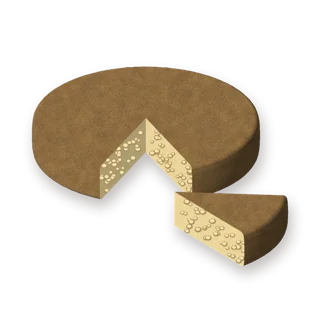
Latteria is the name of the traditional Friulian cheese made in the latterie turnarie, the village dairies that work their members' milk in turn. The Slow Food description gives raw cow's milk from two milkings, partly skimmed by natural creaming, worked into a semi-cooked straw-coloured paste with scattered eyes that shrink with age. The Campolessi wheel is a Slow Food presidium, and the cheese is on the Friuli-Venezia Giulia list of traditional agri-food products. Wikipedia's article on frico names aged Montasio, Latteria or malga cheese of 6 to 12 months as the cheese for that dish.
Taste: Young wheels are sweet, as Latteria di Mortegliano describes its young Mortean. The paste is compact and straw-coloured, with scattered eyes that shrink with age, per the Slow Food presidium description. Aged wheels of 6 to 12 months are the ones grated or fried into frico.
Ageing: from fresh to aged; wheels of 6 to 12 months are the ones grated or fried for frico
Made in: Friuli, traditionally in the village latterie turnarie; the Slow Food presidium cheese is made at Campolessi, Gemona del Friuli
Cow milkSemi, hardAlso Çuç di mont
The cheese of the summer mountain dairies, made from the milk of cows grazing at high altitude in the Friulian Dolomites and the mountains of Carnia and aged for up to a year. Wikipedia's article on Friulian cuisine says each malga has few animals, so the cheese changes from malga to malga and season to season, from straw to deep yellow or even orange, with fine eyes and a firm but soft paste. Turismo FVG credits young cheesemakers with its revival and mentions a Slow Food presidium. The cheese is on the Friuli-Venezia Giulia list of traditional agri-food products.
Taste: A unique and intense flavour, says Turismo FVG, after ageing that can last up to a year. Wikipedia's article on Friulian cuisine describes a straw to deep yellow or orange cheese with fine eyes and a firm but soft paste that varies by malga and season.
Ageing: up to a year
Made in: Mountain pastures of the Friulian Dolomites and of Carnia

Cow milkSemi, soft
A cheese born in Carnia from the need to use up defective wheels of malga cheese: they are minced and worked together with extra milk, cream, salt and pepper. After a night or two of rest it is aged for about 40 days. Turismo FVG calls the result soft and savoury, with a piquancy that varies from cheese to cheese. Caseificio Alto But makes its version from its own cheese of several ageings, ground and kneaded with salt, pepper and cream. The cheese is on the Friuli-Venezia Giulia list of traditional agri-food products.
Taste: Soft and savoury, with a piquancy that varies from one cheese to the next. Wikipedia's article on Friulian cuisine describes the same recipe of shredded cheese, salt, pepper, milk and cream.
Ageing: about 40 days, after a rest of one or two nights
Made in: Carnia
Cow milkSemi, softAlso Asìn
Despite the name, not a donkey's milk cheese: Wikipedia takes the name from Monte Asio in the Pordenone hills. It is a cow's milk cheese of the upper Val d'Arzino. Turismo FVG credits it to secret salting brines kept in wooden vats and handed down over generations. It comes in two versions, a classic aged one and a soft fresh one, both savoury and piquant. Wikipedia describes a soft paste similar to the salted cheese of Carnia. The cheese is on the Friuli-Venezia Giulia list of traditional agri-food products.
Taste: Savoury and piquant according to Turismo FVG, in both the classic aged and the soft fresh version. The source suggests it with polenta or in summer salads, and Wikipedia describes a soft paste.
Ageing: a soft fresh version and a classic aged version
Made in: Alta Val d'Arzino, Friuli
Cow milkSemi, softAlso Formadi salat
A soft cow's milk cheese made savoury by its time in brine. The Latteria turnaria di Campolessi sells it as a soft-paste cheese without visible eyes, from white to pale yellow. Wikipedia's article on the Val d'Arzino calls the formadi salat a soft cheese given its sapidity by brine marinating, and the same article describes the balote, a polenta ball filled with cheese and cooked on embers. The cheese is on the Friuli-Venezia Giulia list of traditional agri-food products.
Taste: Salty by design, with a soft paste and no eyes; the colour runs from white to pale yellow, per Latteria di Campolessi. Wikipedia calls it a soft cheese made savoury by brine marinating.
Made in: Friulian mountains; Val d'Arzino and Carnia are the places the sources name

Cow milkWheyNatural rindAlso Scuete fumade
The smoked ricotta of Carnia: whey is heated until it coagulates, then pressed and smoked. Turismo FVG describes a thin brown crust and a compact white paste, eaten fresh or aged, and says juniper branches do the smoking; Caseificio Alto But smokes its own with beech shavings. Wikipedia's article on Friulian cuisine names cjarsons dressed with melted butter and smoked ricotta, and Alto But says aged pieces are grated over pasta and gnocchi. The region's list of traditional agri-food products carries it as Ricotta affumicata di malga.
Taste: A compact white paste under a thin brown crust, with a smoke note from juniper or beech. At 6 to 7 days it is eaten like a cheese; at 2 to 3 months it grates over pasta and gnocchi, as Caseificio Alto But describes.
Ageing: eaten at 6 to 7 days like a cheese, or aged 2 to 3 months for grating
Made in: Carnia