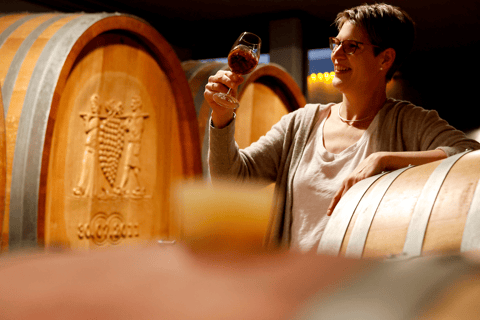
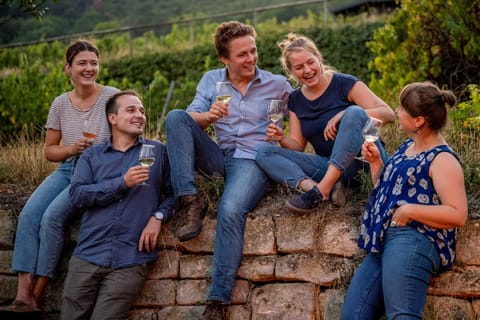
North-east of the Pfalz on the warm sandstone slopes between Heppenheim and Darmstadt, the Hessische Bergstrasse covers around 460 hectares as Germany's smallest wine region. Bensheim anchors the route with the Staatsweingut as headline estate.
Pours: Hessische Bergstrasse Riesling trocken, Bergstrasse Weissburgunder, Bergstrasse Spaetburgunder
Tip: The Hessische Bergstrasse is small enough for a real half-day; combine Bensheim's Staatsweingut with a Heppenheim village tasting before driving back to the Pfalz.
East across the Rhine from the Pfalz, Heidelberg pairs a Baroque old town below a sandstone castle with a long Hauptstrasse of wine bars and restaurants. Pfalz and Baden bottlings dominate the city wine lists.
Pours: Pfalz Riesling at the Hauptstrasse wine bars, Baden Pinot at the Marktplatz, Local Sekt
Tip: Park at the Bismarckplatz and walk the Hauptstrasse from the Alte Bruecke to the Universitaetsplatz; the wine bars cluster around the side streets off the Marktplatz.
East of the Mittelhaardt on the Rhine, Speyer holds the 1030 Romanesque imperial cathedral (UNESCO World Heritage) and a long Maximilianstrasse of Pfalz-pouring wine bars.
Pours: Pfalz Riesling at the Rathausplatz, Pfalz Spaetburgunder, Speyer Brezel pairing
Tip: Combine the cathedral with the Historisches Museum to see the Roemerwein, a 4th-century glass amphora of still-liquid Roman wine.
Directly north of the Pfalz across the Worms-Mainz axis, Rheinhessen covers around 26,700 hectares with the red-slate Roter Hang between Nierstein and Nackenheim. The two regions share the Rhine and the warm continental climate.
Pours: Rheinhessen Riesling trocken, Niersteiner Roter Hang Riesling, Rheinhessen Spaetburgunder
Tip: Combine a morning at the Worms cathedral with afternoon tastings on the Roter Hang above Nierstein; Worms sits on the border between the two regions.
At Schweigen the Pfalz meets Alsace, with Cleebourg and Wissembourg a short drive across the French border. The Alsace wine route runs south from there through Marlenheim and the Vosges foothills to Strasbourg.
Pours: Alsace Riesling Grand Cru, Alsace Pinot Gris, Alsace Gewuerztraminer
Tip: Drive from Schweigen down to Wissembourg and Cleebourg on a single morning; the two villages give the cleanest read of the Alsace style closest to the Pfalz border.
South-east across the Rhine from the Pfalz, the Kraichgau and Badische Bergstrasse run south from Heidelberg through Heilbronn into Baden. The region anchors Germany's Pinot heartland alongside the Pfalz with a complementary house style.
Pours: Baden Spaetburgunder, Baden Weissburgunder, Baden Riesling trocken
Tip: Pair the Pfalz Spaetburgunder of Becker or Rings with a Baden Pinot trip into the Kraichgau; the Rhine-bridge drive from Speyer reads the contrast cleanly.