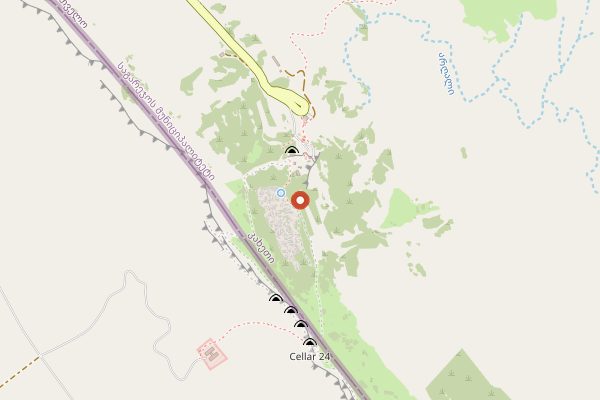
A reserve established in 1912, covering 24,451 hectares and running from 590 up to 3,500 m, with a strict nature reserve alongside a managed reserve that is open to walkers.
Tip: Five trails start from the central entrance, to the Grouse and Ninoskhevi waterfalls, the 11th century Machi castle and Black Rock Lake.
The high country of Akhmeta municipality, run as a protected area since 2003, with 11 marked routes, guides and horses for hire and an administration that moves up to Omalo for the season.
Tip: The season is short, June to October; the winter administration sits down in Lower Alvani because the road above is impassable the rest of the year.
35,292 hectares in Dedoplistskaro at the dry southern end of Kakheti, founded in 1935, taking in the Pantishara and Vashlovani massif at 300 to 600 m plus Eagle Gorge and the Takhti-Tepa mud volcanoes.
Tip: You have to check in at the visitor centre in Dedoplistskaro with valid identification before going into the national park.
King Levan's capital, with the Church of the Archangels built between 1565 and 1577, a three-storey castle, a bell tower and a wine cellar. Shah Abbas I destroyed the town in 1615.
Tip: The bell tower holds a small museum with archaeological finds and a 16th century cannon, so allow time above the church rather than just the courtyard.
A monastery founded in the 6th century above the ruins of an ancient settlement, between Kvareli and Shilda. Excavation from 1984 turned up two basilicas, a fire temple and a stone winery.
Tip: The winery site, five presses and two cisterns under a 20 by 20 metre roof, is the reason to come here rather than the church alone.
A convent 2 km from Sighnaghi, first built in the 9th century on the burial site of Saint Nino, the 4th century evangelist of Georgia. Her relics are still there and it draws pilgrims year round.
Tip: Saint Nino's spring sits about 3 km below the convent under a chapel built in the 1990s; it is a walk down and a harder walk back.