Cow milkFreshAlso Claqueret, tomme daubée
A fresh Lyon preparation rather than an aged cheese: fromage blanc beaten with chopped shallots, parsley, chervil and chives, oil, vinegar, white wine and seasoning, then folded with whipped cream, in the Observatoire des produits du terroir's recipe. The Observatoire stresses it is not offal despite the name and says it was a very important food of the canuts, the silk weavers. French Wikipedia finds the term already defined in Clair Tisseur's 1894 dictionary of Lyon speech, so the 1934 attribution to Paul Lacombe of Léon de Lyon can be questioned. The Observatoire lists Beaujolais AOC among its wines.
Taste: A cool, creamy, lightly sharp fresh cheese with shallot and herbs. The Observatoire rates it 4 out of 5 for saltiness, 2 for acidity and 1 for bitterness and sweetness. In Lyon, says French Wikipedia, it comes in a bowl with toasted bread and cooked potatoes, or dresses a frisée, rocket or dandelion salad.
Ageing: None; a fresh preparation, rested in the fridge at least 2 to 3 hours before serving
Made in: Lyon and the Lyonnais

Cow and goat milkOtherAlso Fromage fort
A Lyon spread of old blue and goat cheeses worked with white wine, salt and pepper and kept in a stoneware pot, where the starter ferments for several months to a year before being mixed with fresh curd. The Observatoire des produits du terroir also lists leek broth, butter, cream and Burgundy marc. French Wikipedia ties it to the silk workers of the Croix-Rousse, says it is known in the Lyonnais, the Dombes and the Beaujolais, and says bouchon customers spread it on toast from a pot on the bar.
Taste: Very strong. The Observatoire scores it 5 out of 5 for power, 4 for bitterness, 3 for saltiness and 2 for acidity, and lists toasted bread, potatoes and other root vegetables, warm buckwheat waffles and brandy or marc to go with it.
Ageing: The starter ferments in a stoneware pot for several months, up to a year
Made in: Lyon, especially the Croix-Rousse hill; known in the Lyonnais, the Dombes and the Beaujolais

Cow milk, rawOtherNatural rindAlso Arôme de gêne de marc, arôme au vin blanc
A small flat disc of soft-paste cow's milk cheese, sometimes made with goat's milk, made in the Lyon region and macerated for three weeks to a month in white wine, or in grape stalks steeped with red wine. The Observatoire describes it as coated with grape pomace (gênes de marc). French Wikipedia gives 6 to 7 cm across, 3 cm thick and about 100 g, says cheesemongers buy them a little young in tubs of 15 or 40, and lists it as unprotected. Its Lyon cuisine article puts it on the Lyon cheese board beside the tomme du Beaujolais.
Taste: The Observatoire describes complex aromas, the fruitiness of milk with slightly winey notes, and a creamy texture that melts on the palate at room temperature. Le Guide du Fromage adds a slight acidity. French Wikipedia says it is eaten at the end of a meal with a wine of the region.
Ageing: Macerated for 3 weeks to a month; cheesemongers buy them slightly young
Made in: Lyon region, Rhône department

AOP, first protected 2009Goat milk, rawSemi, softNatural rind
A tiny disc of whole raw goat's milk from the Pilat hills, 4.2 to 5 cm across and 1.9 to 2.4 cm high, about 35 g. INAO says it can be sold from 8 days old and should not be eaten too dry, and that its fine surface flora can be ivory, white or blue. It became an AOC by Décret 2009-49 of 13 January 2009 and an EU AOP in 2013, and French Wikipedia lists it on the Lyon cheese board. INAO adds that Condrieu was its main market in the 19th century and that the name probably comes from rigol or rigot, small streams.
Taste: Firm, smooth paste that melts in the mouth, with hazelnut, forest floor and whey aromas, according to INAO. Le Guide du Fromage calls it moderately salted, and French Wikipedia puts the best eating from May to August.
Ageing: At least 8 days before sale
Made in: 48 communes of the Loire and Rhône on the Pilat massif, south-west of Lyon

AOP, first protected 2010Goat milk, rawOtherNatural rind
A big raw goat's milk cheese shaped like a small barrel, made from a lactic curd. The EU single document gives 250 to 310 g after at least 16 days, 60 to 70 mm across at mid-height and 70 to 85 mm tall, under a rind mostly of geotrichum with blue penicillium spots that may appear; INAO calls it among the largest goat cheeses, at about 300 g. It became an AOC in 2010 and an EU AOP in 2014. The area is a 60 km radius around Charolles and, in the Rhône, takes in the canton of Monsols and communes of the cantons of Beaujeu and Lamure-sur-Azergues, among them Claveisolles in the Beaujolais hills.
Taste: INAO lists grass, hay, fresh straw and mushroom, then hazelnut and butter, on a fine, smooth, creamy paste; the EU single document calls the paste cream-coloured, firm and smooth. The ivory rind can take a light blue down as it ages.
Ageing: At least 16 days
Made in: About 60 km around Charolles: Saône-et-Loire, with parts of the Loire, Allier and 21 communes of the Rhône
IGP, first protected 2013Cow milk, bothSoft, bloomyBloomy rindAlso Saint-Marcellin IGP
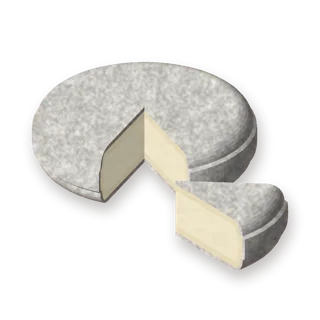
A soft round of cow's milk from the Dauphiné, protected as an IGP since 2013. The EU single document gives a disc with rounded edges about 7 cm across and 2 cm high, at least 80 g, from whole milk used raw or thermised but never pasteurised; INAO describes a very thin, sometimes slightly wrinkled rind, white, beige to grey-blue. It is not made in the Rhône, but French Wikipedia's article on Lyon cuisine puts it first on the Lyon cheese board, and the consortium credits the Lyon cheesemonger Mère Richard with the soft (moelleux) style taken up by restaurants such as Paul Bocuse's.
Taste: The consortium describes the dry style as frank and milky with fruity notes, the blue as a cheese of character with mushroom and forest floor aromas, and the soft as creamy, with dried fruit, honey and cream notes. INAO calls it moderately salted.
Ageing: At least 10 days after renneting before sale, according to the EU single document; the consortium's blue style is aged longer in the cave
Made in: Isère, Drôme and Savoie, centred on Saint-Marcellin
Cow milk, bothSoft, bloomyBloomy rind
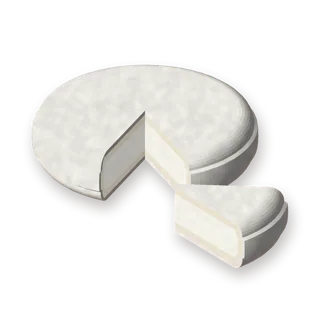
A soft cow's milk cheese under a white flowery rind. The Saint-Marcellin and Saint-Félicien committee gives 8.5 to 12 cm across, 2 to 4 cm high and 150 to 220 g, made from the milk of 150 dairy farms. It has no protected name yet: the committee says an IGP would tie it to 6 departments and 708 communes, and French Wikipedia says producers filed the application on 4 September 2023. Wikipedia says the trademark was registered on 6 November 1956 by Marius Boucher of Villeurbanne, and its Lyon cuisine article lists the cheese on the Lyon cheese board as one from the south of Lyon.
Taste: Soft and melting under the rind, lightly salted, with a gentle taste and a creamy, smooth texture, according to the committee. French Wikipedia says it is thicker, richer and creamier than Saint-Marcellin.
Ageing: About four to six weeks; best from April to September, according to French Wikipedia
Made in: Traditionally the Rhône, Ain, Drôme and Isère