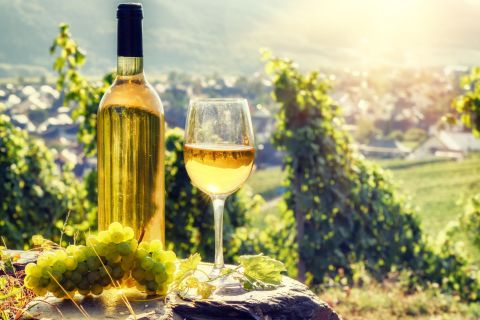
Basel sits where France, Germany and Switzerland meet at the Rhine bend. Beyond the Kunstmuseum and Renaissance old town, the surrounding Aargau and Baselland vineyards offer Swiss Pinot Noir and Chasselas from steep south-facing slopes.
Pours: Swiss Pinot Noir, Chasselas from neighbouring vineyards, Swiss Riesling-Sylvaner
Tip: Swiss bottles rarely leave the country so use the day to taste wines you cannot buy outside Switzerland; the city is also a major art destination with the Fondation Beyeler a short tram ride away.
The Bodensee, where Germany, Switzerland and Austria meet, is the warmest and southernmost German wine zone. Muller-Thurgau dominates, with Spatburgunder and Weissburgunder on the lake's south-facing slopes; the Meersburg shoreline is the postcard side.
Pours: Muller-Thurgau, Bodensee Spatburgunder, Bodensee Weissburgunder
Tip: Easiest as a two-day add-on rather than a same-day round trip; combine a lake-side wine afternoon with a steam-train ride along the German shoreline.
Often overlooked, the Cotes de Toul AOC in Lorraine makes its name on Vin Gris, a pale pressed-Pinot rose-like style. Auxerrois and Pinot Noir round out a tiny appellation that crystallises what France's far north-east wine country looks like outside Alsace.
Pours: Cotes de Toul Gris (Vin Gris), Cotes de Toul Auxerrois, Cotes de Toul Pinot Noir
Tip: Vin Gris is the wine to chase here; serve it as you would Provence rose with charcuterie or quiche lorraine, the region's signature savoury tart.
France's sparkling-wine capital sits four hours west of Alsace by car. Reims for the Gothic cathedral and the major houses, Epernay for the Avenue de Champagne and its show cellars, the obvious counterpart to Alsace's Cremant slope.
Pours: Brut NV, Blanc de Blancs, Vintage Champagne, Rose de Saignee
Tip: Champagne is a long day; turn it into a weekend by booking Reims accommodation and visiting two houses each day, mixing a grande marque and a small grower for contrast.
Three hours south of Colmar lies Beaune and the Cote d'Or, a long-standing benchmark for Pinot Noir and Chardonnay. The 2015 UNESCO Climats put 1,247 named plots from Dijon to Maranges on the world heritage list.
Pours: Gevrey-Chambertin, Meursault, Puligny-Montrachet, Pommard
Tip: Pair a Burgundy weekend with Alsace by basing yourself in Beaune for two nights and Colmar for two; the autoroute connects them in under three hours.
Two and a half hours south-west, the Jura makes a distinctive style: oxidative Savagnin, the sherry-like Vin Jaune aged six years under a yeast veil, and Chateau-Chalon, the AOC reserved for Vin Jaune alone.
Pours: Vin Jaune, Arbois Savagnin, Cremant du Jura, Macvin du Jura
Tip: Buy a clavelin, the squat 62cl bottle unique to Vin Jaune, in Arbois or Chateau-Chalon; the wine is a classic match for Comte cheese and roast chicken.