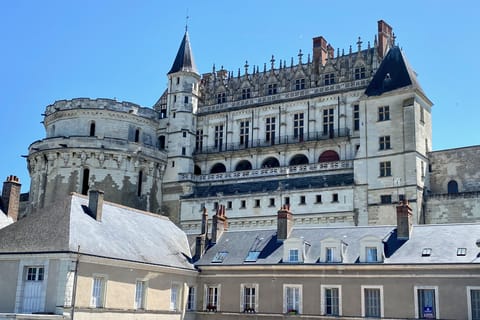
3-day Private Loire Castles Trip 2 Wine tastings by Mercedes
3-day Private tour to Top 7 Loire Valley Castles with 2 Wine tastings. Chenonceau, Amboise, Chambord, Blois, Chaumont, Da Vinci Clos Luce, Villandry by Mercedes. Live ...
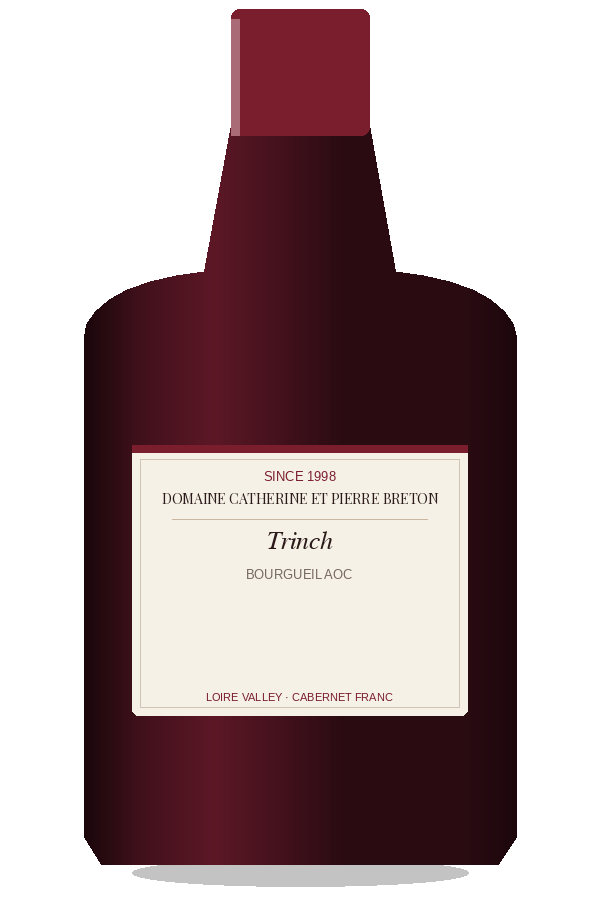 Ruby, medium depth
Still Red · Bourgueil AOC · Loire Valley
The Bretons' natural-leaning gateway Bourgueil. Crunchy, juicy and low-sulfite Cabernet Franc, picked from younger gravel-terrace parcels and vinified for early drinking.
| Critic | Vintage | Score |
|---|---|---|
| Vinous reviewed 2022 | 2020 | 90/100 |
Scores as published by each critic for the vintage shown.
Aroma: crushed raspberry, wild violet, fresh herb, wet pebble
Palate: red cherry, soft tannin, saline mineral, juicy length
The Bretons' natural-leaning gateway Bourgueil. Crunchy, juicy and low-sulfite Cabernet Franc, picked from younger gravel-terrace parcels and vinified for early drinking.
Catherine and Pierre Breton established the domaine in 1982 and converted to organic by 1991 and biodynamic shortly after. Trinch was launched in 1998 as their natural-leaning, low-sulfite gateway cuvee.
Crushed raspberry, wild violet, fresh herb and wet pebble on the nose; red cherry, soft tannin, saline mineral and a juicy length on the palate. Medium-bodied with low tannins and high acidity.
Drink between 2 and 8 years from vintage, lightly chilled to 14C. The natural style is best in its first three years.
Charcuterie and rillettes de Tours is canonical; hanger steak with shallots and goat-cheese omelette with chives also pair well.
Yes. The Bretons work without animal-derived fining agents and minimal sulfites across the natural range.
3-day Private tour to Top 7 Loire Valley Castles with 2 Wine tastings. Chenonceau, Amboise, Chambord, Blois, Chaumont, Da Vinci Clos Luce, Villandry by Mercedes. Live ...
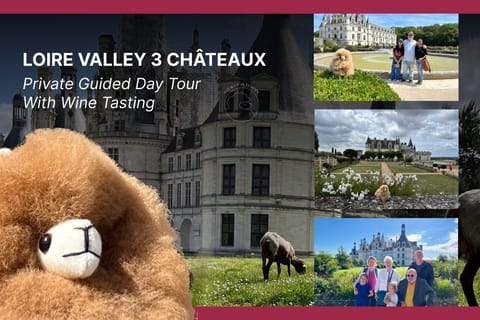
Discover the Loire Valley and visit its three most prestigious castles of your choice on a private guided tour, at your pace, according to your wishes
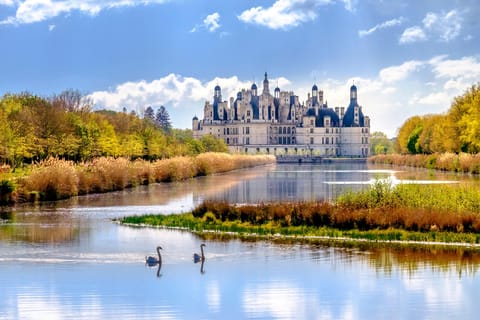
Escape Paris for a magical day in the Loire Valley. Explore fairytale castles, wander charming Blois, and enjoy a local wine tasting along the way.