
Private Rhône-Valley wine tour
Private wine tour of the Rhône Valley, a day out in France tasting great wines in a unique atmosphere.
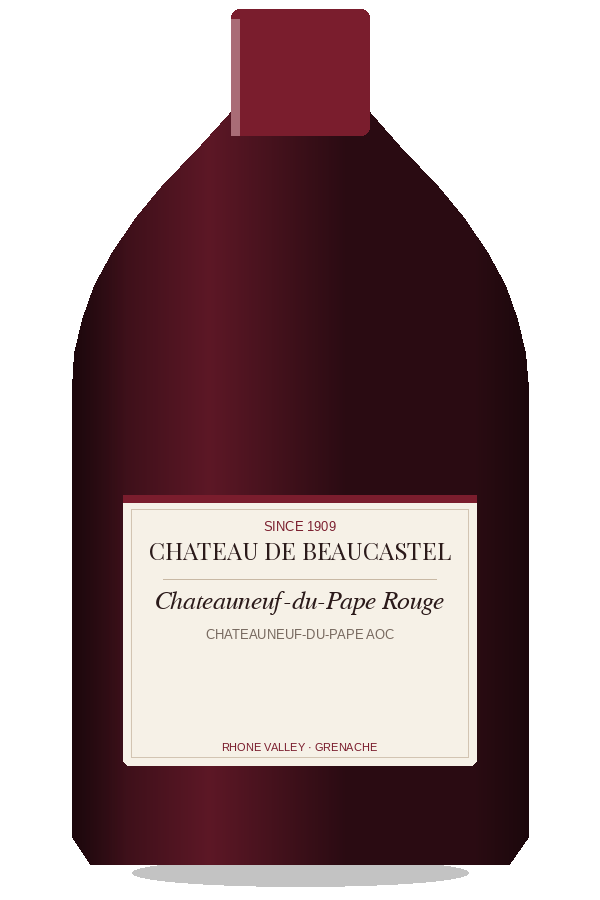 Deep garnet
Still Red · Chateauneuf-du-Pape AOC · Rhone Valley
A structured Mourvedre-led Chateauneuf with deep garnet colour, garrigue and leather on the nose, plush fruit on the palate and a firm, mineral finish.
No critic score is published for this bottle that we can cite with a reviewer, a vintage and a review year, so none is shown. The rating in the header is our own.
Aroma: garrigue, black cherry, leather, iron, herbs de Provence
Palate: dark plum, tobacco, roasted herbs, dried fig, earthy minerality
A structured Mourvedre-led Chateauneuf with deep garnet colour, garrigue and leather on the nose, plush fruit on the palate and a firm, mineral finish.
Allow 95 minutes from open to pour.
Pierre Tramier planted the estate in 1909; the Perrin family acquired it in 1950. Beaucastel is the only Chateauneuf estate to cultivate all 13 permitted grape varieties. The unusually high Mourvedre content distinguishes the wine from Grenache-dominant peers.
On the nose, garrigue, black cherry, leather, iron, herbs de Provence. On the palate, dark plum, tobacco, roasted herbs, dried fig, earthy minerality. Structurally full-bodied, firm tannins, medium acidity with a long finish. A structured Mourvedre-led Chateauneuf with deep garnet colour, garrigue and leather on the nose, plush fruit on the palate and a firm, mineral finish.
Drink 5-25 from vintage. Young vintages benefit from 30-90 minutes of decanting; mature bottles should be handled carefully for sediment.
Leg of lamb with rosemary and garlic is the canonical pairing. Other strong matches include Roasted wild boar and Aged Comtom or Tome de Chevre. Mourvedre's iron-and-herb profile is a classic match for roasted lamb.
The blend is Grenache (30%), Mourvedre (30%), Syrah (10%), Counoise (10%), Cinsault (5%). The wine is classified as Chateauneuf-du-Pape AOC.
Private wine tour of the Rhône Valley, a day out in France tasting great wines in a unique atmosphere.
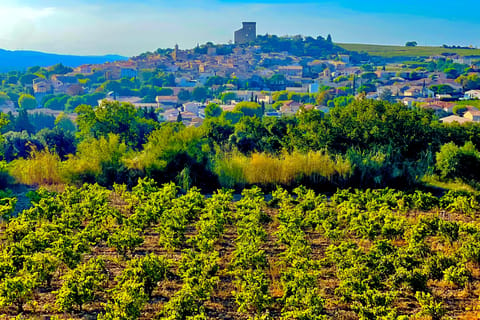
Discover two of the best preserved Roman monuments in the world: The Roman Theatre of Orange and the Aqueduct of the Pont du Gard (UNESCO Sites) and enjoy a wine tasti...
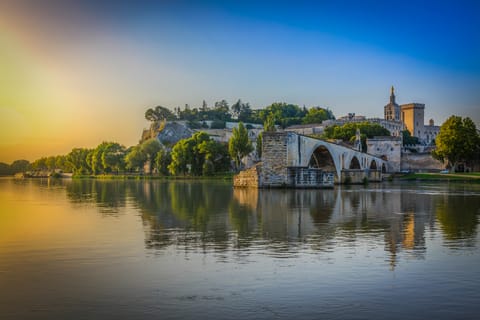
Explore the beautiful city of Avignon. See the Papal Palace, enjoy some lunch, visit Chateau Sainte-Roseline, and taste the wine of the Provence.