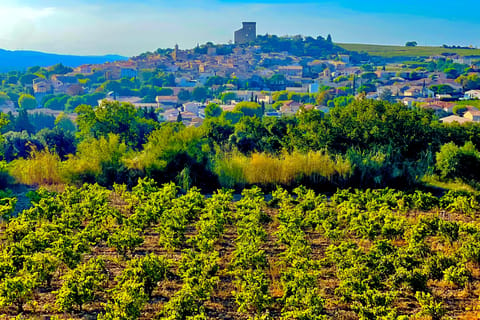
The dominant red grape of the Northern Rhone, expressed on the granite terraces of Cote-Rotie, Hermitage and Cornas. In Cote-Rotie it is co-fermented with up to 20 percent Viognier, gaining floral lift and aromatic complexity. On Hermitage it produces concentrated, age-worthy wines capable of 40-plus years in bottle. In Cornas (the only Northern Rhone AOC permitting no other grape in reds) it stands alone on a granite amphitheatre, dark and mineral. In the Southern Rhone, Syrah is a blending partner (typically 10-15 percent) in Chateauneuf-du-Pape, Gigondas and Vacqueyras, adding structure and pepper.
An aromatic white grape native to the Rhone Valley, found primarily in the Condrieu appellation and the monopole Chateau-Grillet, on schist and granite soils above the Rhone.
The principal white grape of Hermitage, Crozes-Hermitage, Saint-Joseph and Saint-Peray. Marsanne is a thick-skinned, low-acid, full-bodied white that goes through a notoriously closed adolescent phase (around 5-10 years) before opening into a honeyed, almond-paste and beeswax richness that can last 30 or more years in the best Hermitage bottlings. Blended with Roussanne in most appellation whites; in Saint-Peray it is made into both still and traditional-method sparkling wine.
Hermitage and Chateauneuf-du-Pape's second white grape, blended with Marsanne in the north and used in much larger proportions in Southern Rhone whites.
The backbone of Southern Rhone reds and the dominant variety in Chateauneuf-du-Pape (typically 60-80 percent of the blend). Grenache is thin-skinned, high in alcohol and sugar, with a generous red-fruit character, white pepper and dried herb quality. On the galets roulees plateau it reaches richness and complexity; on sandy soils (as at Rayas) it produces wines of transparent delicacy and extended longevity. The Southern Rhone is a primary source of old-vine Grenache; vines over 80-100 years old produce wines of high concentration at minimal yields.
The dark, tannic, late-ripening component of the Southern Rhone GSM blend, contributing backbone, game and iron-earth complexity to Chateauneuf-du-Pape, Gigondas and Vacqueyras.
A Southern Rhone blending variety providing freshness, aromatic lift and lower alcohol in Chateauneuf-du-Pape, Tavel and general Cotes du Rhone.
The white-berry mutation of Grenache and one of the principal varieties in white Chateauneuf-du-Pape blends. Grenache Blanc contributes body, alcohol and a waxy, melon-and-pear fruit character; it is often blended with Roussanne, Clairette, Bourboulenc and Picpoul for the CdP blanc. Chateau de Beaucastel's white blends often include Grenache Blanc alongside the estate's celebrated old-vine Roussanne. At its best it produces whites of considerable richness, best drunk young or after long ageing.
The grape behind Muscat de Beaumes-de-Venise AOC (granted 1945). Muscat a Petits Grains Blancs (small white berries) grown on the volcanic-influenced soils of Beaumes-de-Venise, at the foot of the Dentelles de Montmirail, produces floral fortified whites with apricot, lychee and orange blossom, the fortification preserving varietal freshness. Best served slightly chilled as an aperitif or with foie gras and light fruit tarts.
An ancient Provencal white grape and one of the oldest-cultivated varieties in the Southern Rhone, widely planted in Chateauneuf-du-Pape, Tavel, Lirac and general Cotes du Rhone.