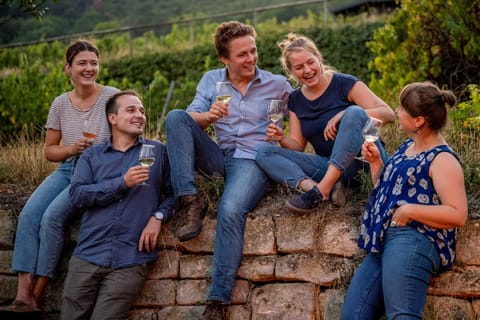
The grapes that define Pfalz: the canonical varietals and how the region expresses them.

Canonical grapes of Pfalz

Riesling

Riesling accounts for roughly 25 percent of Pfalz plantings, around 5,883 hectares and the prestige grape of the Mittelhaardt. The 1828 Bavarian classification rated Forster Kirchenstuck at the maximum 65 points, with Jesuitengarten, Pechstein and Ungeheuer in the same tier; the VDP reaffirmed these sites as Grosse Lage when Grosses Gewachs launched in 2002. Forst grows Riesling on basalt-flecked calcareous loess, Deidesheim on Hohenmorgen and Kalkofen limestone, Konigsbach's Idig on calcareous clay (Christmann), Kallstadter Saumagen on limestone (Koehler-Ruprecht), Hochheim's neighbour at Bad Durkheim on sandstone and basalt, and the southern Sudliche Weinstrasse Kastanienbusch and Im Sonnenschein on Buntsandstein and slate. Pfalz Riesling typically shows lime, white peach, yellow apple and the basalt-and-limestone minerality of the central Weinstrasse.

Spatburgunder (Pinot Noir)

Spatburgunder accounts for around 12 percent of Pfalz plantings and around 1,760 hectares, with the Sudliche Weinstrasse around Schweigen, Birkweiler and Siebeldingen as the centre of gravity. Friedrich Becker at Hauptstrasse 29 in Schweigen farms Sonnenberg, Sankt Paul, Kammerberg and Heydenreich on Muschelkalk limestone with vines crossing into French Alsace and bottled as Pfalz under a wine-law exception. Rebholz, Dr. Wehrheim and Bernhart all bottle Buntsandstein and slate Pinot from Birkweiler and Schweigen. In the north, Christmann at Konigsbach and Knipser at Laumersheim work calcareous-clay Pinot, with Knipser's Kirschgarten as the historic German Pinot Noir reference from the 1990s.

Weissburgunder (Pinot Blanc)

Pinot Blanc, called Weissburgunder in Germany, is a Pfalz signature with widespread plantings on calcareous soils across both the Mittelhaardt and the Sudliche Weinstrasse. Munzberg at Godramstein bottles a Weisser Burgunder GG from the Munzberg Schlangenpfiff Grosse Lage on Muschelkalk limestone, Bergdolt Klostergut St. Lamprecht is a long-standing Pinot Blanc specialist, and Rebholz, Burklin-Wolf and Pfeffingen all carry Weissburgunder Grosses Gewachs in their portfolios. Styles are typically dry, medium-bodied with pear, apple and almond, and routinely barrel-aged at the top tier where they age 10-20 years.

Grauburgunder (Pinot Gris)

Pinot Gris, called Grauburgunder in Germany, is widely planted across the Pfalz and forms a significant part of estate portfolios in both the Mittelhaardt and the Sudliche Weinstrasse. Rebholz at Siebeldingen, Dr. Wehrheim at Birkweiler, Munzberg at Godramstein and Knipser at Laumersheim all carry Grauburgunder in their lineups, often as Erste Lage or single-vineyard bottlings on calcareous and Buntsandstein soils. Styles are typically dry, medium- to full-bodied with stone fruit, pear and a bitter-almond finish, and the warmer Pfalz climate gives noticeably richer wines than the equivalent grape in Baden or Mosel.

Dornfelder

Dornfelder is the Pfalz volume red, planted on roughly half the Riesling area and the dominant red grape for the region's Gutsweine and supermarket bottlings. Bred in 1955 by August Herold at the Weinsberg viticultural institute as a Helfensteiner x Heroldrebe cross, Dornfelder gives deep colour, soft tannins and dark cherry-plum fruit, often bottled in fruity off-dry or barrique-aged dry styles. Borell-Diehl at Hainfeld and Lergenmuller at Hainfeld both feature Dornfelder in their wider portfolios; the Mittelhaardt grandees rarely carry it but the Sudliche Weinstrasse cooperatives and small estates rely on it for everyday-drinking reds.

Scheurebe

Scheurebe was bred in 1916 by Georg Scheu in Alzey as a Riesling x Bukettrebe cross and found its Pfalz signature at Muller-Catoir in Haardt and Pfeffingen in Ungstein, the two reference estates that carried the variety through the late 20th century when most German producers were pulling it out. Pfalz Scheurebe ranges from bone-dry through Spatlese and Auslese to nobly sweet Trockenbeerenauslese, with aromatic markers of pink grapefruit, cassis leaf, elderflower and exotic mango on the riper sides. Koehler-Ruprecht and Eugen Muller also carry Scheurebe Spatlese and Auslese bottlings.

Muller-Thurgau

Muller-Thurgau remains a significant volume grape in the Pfalz, planted on warmer, lower-elevation sites and used in entry-level Gutsweine, Federweisser and the kabinett-light category. Bred in 1882 by Hermann Muller at Geisenheim from a Riesling-Madeleine Royale cross, the variety is now widely grown across Germany but Pfalz remains one of its larger producers by area. Styles are typically dry to off-dry, light-bodied, with green apple, peach and a soft muscat lift, intended for early drinking. Larger estates such as Fitz-Ritter and Borell-Diehl carry Muller-Thurgau alongside Riesling and the Burgunder family.

Silvaner

Silvaner sits as a Pfalz heritage variety with a modest but stable footprint, planted on warmer, lighter sites and bottled as a dry, food-friendly white. Koehler-Ruprecht at Kallstadt bottles a Steinacker Silvaner alongside Saumagen Riesling, Odinstal at Wachenheim carries Silvaner under Demeter certification, and Muller-Catoir at Haardt grows it on the Burgergarten parcels. Styles are typically dry, medium-bodied with green apple, hay, white pepper and a mineral spine from the limestone and basalt soils, and serve as a foil to the more flamboyant Riesling and Scheurebe in Pfalz line-ups.
Signature Grapes in Pfalz, FAQ

When is the best time to visit Pfalz for wine?

Peak wine-travel season in Pfalz is spring through autumn, with harvest the standout window.

Do I need an appointment to taste at Pfalz estates?

classified-growth and grand-cru estates require booking days to weeks ahead; smaller family domaines often take walk-ins midweek.

What hours do Pfalz cellars and tasting rooms keep?

most estates open 10:00 to 17:00 by appointment, often closed Sunday and Monday.

How does tipping work at Pfalz tastings?

tipping is not expected at tastings; buying a bottle from the cellar door is the customary thank-you.

What is the one wine to try in Pfalz?

Ask the next local you meet what they would order. Pfalz rewards trust.

← Back to Pfalz wine guide