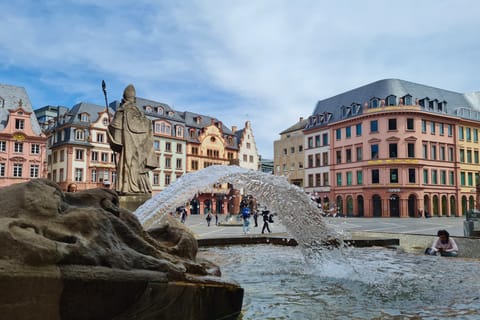
Directly across the Rhine north of Rheinhessen, the Rheingau runs the south-facing river slope from Hochheim through Eltville and Hattenheim to Ruedesheim and Lorch. The two regions trade the title of Germany's classical Riesling heartland with very different stylistic registers.
Pours: Rheingau Riesling trocken, Rheingau Riesling Grosses Gewaechs, Assmannshaeuser Spaetburgunder
Tip: Take the Bingen-to-Ruedesheim car ferry across the Rhine to compare Rheinhessen and Rheingau Riesling on the same weekend; the river crossing is the prettiest stretch of the trip.
Directly south of Rheinhessen across the Worms-Bockenheim axis, the Pfalz covers around 23,500 hectares along the Deutsche Weinstrasse from Bockenheim through the Mittelhaardt to Schweigen. The Forst basalt soils and Deidesheim limestone parcels anchor Germany's other dry-Riesling heartland.
Pours: Pfalz Riesling trocken, Forster Jesuitengarten Riesling Grosses Gewaechs, Pfalz Spaetburgunder
Tip: Drive south from Worms through Bockenheim into the Mittelhaardt; the Deutsche Weinstrasse begins at the Haus der Deutschen Weinstrasse arch at Bockenheim, just over the Rheinhessen border.
Ninety minutes west of Bingen along the A61 and the river bend, the Middle Mosel around Bernkastel, Wehlen and Piesport bottles Germany's sharpest, slatiest, lowest-alcohol Riesling. The Mosel reads as the cool-climate counter-style to the warmer Rheinhessen heartland.
Pours: Mosel Riesling Kabinett, Mosel Riesling Spaetlese, Mosel Riesling Grosses Gewaechs
Tip: Make it an overnight rather than a half-day; the Middle Mosel sundial villages need at least two estate stops to read the slate spectrum from Bernkastel south.
Forty minutes south-west of Bingen across the Nahe river, the Nahe wine region covers around 4,200 hectares of porphyry, slate and quartzite slopes between Bad Kreuznach and Schlossboeckelheim. Doennhoff, Emrich-Schoenleber and Schaefer-Froehlich anchor the modern Nahe Riesling map.
Pours: Nahe Riesling Grosses Gewaechs, Schlossboeckelheim Felsenberg Riesling, Dorsheim Riesling
Tip: Combine Bad Kreuznach with Schlossboeckelheim's Felsenberg vineyard walk; the riverside slope frames the region's most photographed view.
Just north of Bingen along the Rhine Gorge UNESCO World Heritage stretch, the Mittelrhein covers around 460 hectares of steep slate slopes between Bingen, Bacharach and Koblenz. Toni Joost, Ratzenberger and Florian Weingart anchor the modern Mittelrhein Riesling programme.
Pours: Mittelrhein Riesling trocken, Bacharacher Hahn Riesling, Bopparder Hamm Riesling
Tip: Take the riverboat from Bingen to Bacharach for the prettiest approach; the gorge slopes carry their clearest slate light from the Rhine itself.
Roughly 90 minutes east of Mainz across the A3 highway, Franken covers around 6,100 hectares around Wuerzburg, Iphofen and Volkach. Silvaner anchors the regional programme in the signature Bocksbeutel bottle, and the Wuerzburger Stein cliff above the Main is a national heritage site for Riesling and Silvaner.
Pours: Franken Silvaner trocken, Wuerzburger Stein Riesling, Iphoefer Julius-Echter-Berg Silvaner
Tip: Pair a morning at the Wuerzburger Hofkellerei or Buergerspital with an afternoon at the Stein vineyard walk above the Main; the cliff frames the historic city skyline.
Two hours south of Worms across the Pfalz and the French border at Wissembourg, the Alsace wine route runs from Marlenheim through Obernai and Colmar into the Vosges foothills. The cross-border Riesling-and-Gewuerztraminer tradition contrasts the dry Rheinhessen Wonnegau style.
Pours: Alsace Riesling Grand Cru, Alsace Pinot Gris, Alsace Gewuerztraminer
Tip: Plan an overnight rather than a single day; the Vosges-foothill villages from Marlenheim south are too many to taste in one trip from the Rheinhessen base.
Thirty minutes south of Mainz, Worms holds the 1018-founded Romanesque Kaiserdom St. Peter and the Liebfrauenkirche whose vineyards lent the Liebfraumilch its name. The city anchors the southern Rheinhessen border and is the setting of the Wormser Backfischfest in late August.
Pours: Liebfraumilch from the Wormser Liebfrauenkirche slopes, Wonnegau Riesling at the Wormser wine bars, Rheinhessen Spaetburgunder
Tip: Pair the cathedral with a walk to the Liebfrauenkirche vineyards five minutes north; the vineyard plot that named the wine still stands beside the church.